
Oxford Greyhound Trap Statistics — Win Rates, Bias Data and Trends
Best Greyhound Betting Sites – Bet on Greyhounds in 2026
Loading...
Trap 5 wins almost one in four graded races at Oxford Stadium. Trap 6 barely manages one in six. That gap — 23.5% versus 16.0% — is not a minor statistical wobble. It is a structural feature of the track, baked into the geometry of a 397-metre circuit where the first bend arrives fast and forgives nothing. If you bet greyhounds at Oxford without accounting for Oxford trap statistics, you are ignoring the single largest edge the track hands you for free.
Every greyhound track in Britain has some degree of trap bias. Dogs breaking from certain positions reach the first bend with cleaner running lines, shorter distances to travel, or better angles into the turn. What makes Oxford unusual is the magnitude of its bias and the consistency with which it holds across race meetings. The data from Greyhound Stats UK — covering 345 graded-race winners in 2026 — shows a skew that is among the most pronounced at any BAGS venue in the country.
This article breaks down the full trap bias picture at Oxford: overall win rates, how the bias shifts across the three racing distances (253 metres, 450 metres, and 650 metres), why the track geometry produces these patterns, whether the bias holds in open races, and how to use the data without oversimplifying it. There is a difference between knowing that trap 5 is strong and knowing when that information actually translates into a profitable bet. That distinction is what separates a statistic from a strategy.
Oxford Trap Win Percentages — Full Breakdown for 2026
The headline numbers come from Greyhound Stats UK, which tracks every graded result at Oxford on a rolling basis. As of early 2026, based on 345 graded-race winners, the trap-by-trap win rates are as follows: Trap 1 wins 19.7% of the time. Trap 2 wins 17.6%. Trap 3 wins 18.9%. Trap 4 wins 19.9%. Trap 5 wins 23.5%. Trap 6 wins 16.0%.
To understand what these numbers mean, you need a baseline. In a six-dog race with no bias, each trap would win exactly 16.67% of the time — one in six. Any deviation from that figure represents either a structural advantage or disadvantage conferred by the track layout. At Oxford, trap 5 exceeds the baseline by 6.83 percentage points. That is not noise. In statistical terms, across 345 winners, the deviation is large enough to reject the hypothesis that Oxford’s traps are evenly balanced. The track has a genuine, measurable skew.
The distribution is not random in its pattern either. It follows a rough curve: the two strongest traps (5 and 4) sit on the outside-middle of the draw, while the weakest (6 and 2) occupy the extreme outside and inside-middle. Trap 1, despite being on the rail, performs reasonably well at 19.7% — likely because the shortest path around the bend partially offsets the crowding risk. Trap 3, at 18.9%, sits almost exactly at the statistical midpoint. The picture that emerges is one where the outside-middle positions enjoy the cleanest first-bend access, the rail position compensates through distance savings, and the extreme outside and inside-middle traps absorb most of the disadvantage.
A few caveats are necessary before anyone starts backing trap 5 blindly. First, the 345-winner sample is robust for detecting bias but not large enough to pinpoint win rates to the decimal. The true long-run win rate for trap 5 might be 22% or 25% rather than exactly 23.5% — the point is that it is substantially above the baseline, not that the precise figure is fixed. Second, these are graded-race numbers. Graded racing at Oxford uses the standard GBGB classification system, which groups dogs of similar ability. In open races, where the field quality is higher and the ability gap between runners is often wider, the bias behaves differently. We will address that in a later section.
Third, and this is the piece most punters miss, the data alone does not tell you whether to bet. A 23.5% win rate from trap 5 means the dog should be priced at roughly 3/1 in a vacuum — but greyhound races do not happen in a vacuum. Form, going, early pace, and the quality of the field all interact with the trap draw. We will explore how to integrate these factors in the practical betting section below, but for now, the point is that the trap data is a starting input, not a finished answer.
Still, the raw data is the foundation. Without knowing that trap 5 wins 23.5% and trap 6 wins 16.0%, you cannot even begin to assess whether the odds on offer are fair. The first step in any Oxford betting approach is absorbing these numbers. The second step is understanding why they exist.
How Trap Bias Changes Across Oxford’s Three Distances
Oxford runs three distances — 253 metres, 450 metres, and 650 metres — and each produces a different trap bias profile. The overall win percentages cited above blend all three trips together, which is useful as a starting point but masks important variation. A punter backing trap 5 on a 253-metre sprint is playing a fundamentally different game from one backing trap 5 on a 650-metre staying race.
On the 253-metre sprint, trap bias is at its most extreme. This is the shortest trip at Oxford, completed in roughly 15 seconds, with a single bend deciding the result. The track record of 14.85 seconds, set by Jazzy George in March 2026, illustrates how little time there is for a dog to recover from a poor start or a wide run on the turn. Traps 5 and 1 tend to dominate the sprint. Trap 5 benefits from its angle into the bend — the dog arrives at the turn with clean air and a natural racing line that avoids both the rail crush and the wide swing. Trap 1, meanwhile, has the shortest path to travel on the bend itself, so a fast-breaking railer can offset the crowding risk by simply covering less ground. Traps 2, 3, and 6 tend to fare worst on the sprint: the inside-middle positions get squeezed, and the extreme outside must cover too much extra ground for a race that barely lasts four strides after the bend.
At 450 metres, the standard distance, the bias mellows but does not disappear. The race involves two bends, and the start line is positioned such that dogs have a longer run to the first turn — enough for slower breakers to adjust their line. Trap 5 still leads, but trap 4 closes the gap. The 450-metre trip is Oxford’s most commonly run distance, and it generates the largest sample size, so the bias data here is the most reliable. The current 450-metre track record of 26.47 seconds, held by Alright Twinkle since February 2026, came from an open-race setting where the dog had both the class and the draw to dominate. For graded racing, expect competitive times in the 26.8 to 27.5 range, with trap position influencing the first-bend picture but the overall finishing time hinging equally on sustained pace.
The 650-metre staying trip is where the bias begins to wash out. Three or more bends, a race time approaching 39 seconds (the track record is 39.09 by Eagles Respect, January 2026), and the tactical complexity of a longer run all reduce the importance of the starting position. Dogs have time to find a gap, change lanes, and run their preferred line. On the stays, form and stamina are more predictive than the trap draw. That does not mean trap position is irrelevant — a front-runner from trap 5 still has an advantage into the first bend — but the effect diminishes with every additional bend the race includes.
The practical implication is clear: weight your trap bias analysis by distance. On 253-metre sprints at Oxford, the trap draw should be the first thing you look at when reading the card. On 450-metre races, it remains a strong factor but needs to be balanced against form and early pace. On 650-metre stays, let the form guide take the lead and treat the trap draw as a tiebreaker rather than a primary selection criterion. Punters who apply a uniform trap bias across all three distances are over-weighting it on the stays and under-weighting it on the sprints.
Why Trap 5 Dominates at Oxford — Bend Geometry Explained
The numbers tell you that trap 5 wins more often. The geometry tells you why. Oxford Stadium has a circumference of approximately 397 metres, making it one of the tighter circuits among the 18 GBGB-licensed tracks operating in Britain. Tighter circuits produce sharper bends, and sharper bends amplify the advantage of certain starting positions because dogs have less room to adjust their running lines between the traps and the first turn.
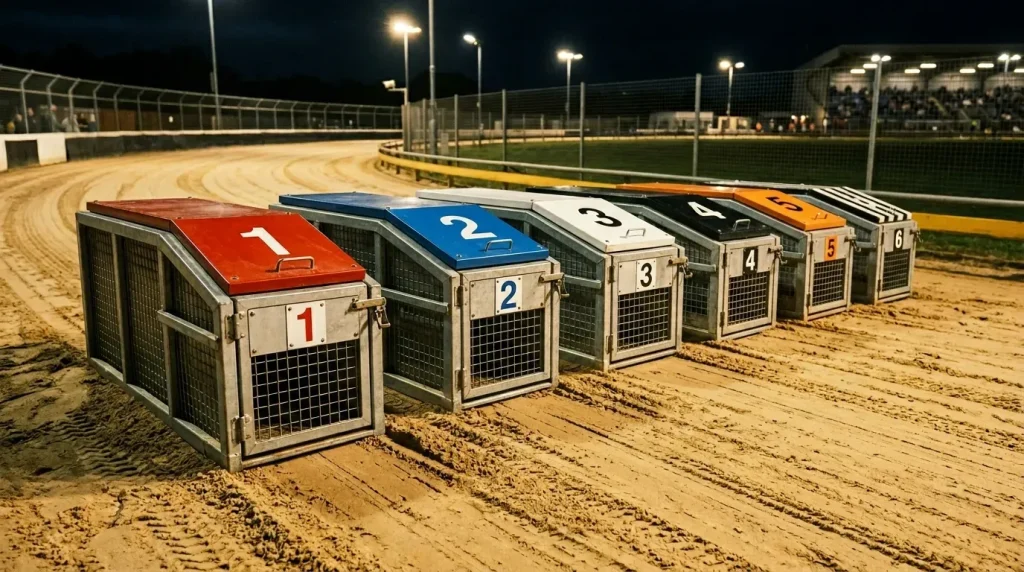
The traps at Oxford are arranged in a straight line across the track, numbered 1 (inside rail) to 6 (outside). When the lids fly open, all six dogs sprint towards the first bend, which arrives within a few seconds on every distance. The dog from trap 5 starts second from the outside. This position gives it three advantages that compound into a higher win rate.
First, trap 5 has clean air on the outside. The dog does not need to worry about being squeezed between two rivals, which is the frequent fate of traps 2 and 3. On a tight bend, even minor contact — a bump, a shoulder — can cost a dog half a length, which on a 253-metre race is effectively the margin of victory. Trap 5 arrives at the bend with room to manoeuvre.
Second, trap 5 does not travel as far as trap 6. On a curved track, the outside lane covers more ground than the inside lane. Trap 6, at the extreme outside, must travel the longest path around every bend. Trap 5, one lane inside, gets most of the positional benefit of being wide without paying the full distance penalty. It is the geometric sweet spot: wide enough to avoid traffic, narrow enough to avoid wasted ground.
Third, the angle of entry matters. Oxford’s bends are shaped such that a dog arriving from the middle-outside position — which is exactly where trap 5 ends up after the break — enters the turn on a natural arc rather than having to fight the camber. Dogs from traps 1 and 2 often hit the bend while still accelerating and then must hold the rail under centrifugal force, which can cause them to lose momentum. Dogs from trap 6 must swing outward before they can even begin to turn. Trap 5 threads the needle.
None of this means trap 5 wins automatically. A slow-breaking dog from trap 5 will lose its positional advantage within the first two seconds of the race. A fast breaker from trap 1 can grab the rail and lead all the way, as the 19.7% win rate for that box confirms — it is the second-strongest overall position. The geometry provides an opportunity; the dog’s speed, breaking ability, and racing style determine whether that opportunity is converted.
It is also worth noting that Oxford’s outside Sumner hare — the mechanical lure that the dogs chase — runs on the outside of the track. This means the hare is closer to the higher-numbered traps at the break, which may influence the initial trajectory of dogs from those positions. Whether this is a genuine factor or simply a coincidence of the layout is debatable, but it is one more element that tilts the physics of the first bend towards the outside-middle.
Graded Racing vs Open Racing — Does the Bias Hold?
The trap statistics discussed so far are drawn from graded racing — the bread and butter of Oxford’s calendar, where dogs are grouped by ability and the fields are closely matched. But Oxford also hosts open races: Category One and Category Two events that attract the best dogs in the country and carry significantly higher prize money. The Sandy Lane Sprint, the bet365 Hunt Cup, and the Challenge Cup are among the marquee fixtures on the Oxford calendar, and the question for the data-minded punter is whether the trap bias that dominates graded racing still applies when the class of runner improves.
The short answer is: less so. Open-race greyhounds are typically faster, more experienced, and more adaptable than their graded counterparts. A dog competing in a Category One event has usually raced at multiple tracks, handled different trap draws, and demonstrated the ability to overcome positional disadvantage through sheer pace and racing intelligence. When the ability gap between the best and worst dog in a race is narrow — as it is in graded racing — the trap draw acts as a tiebreaker that can swing the result. When one dog in the field is demonstrably superior, it tends to win regardless of which box it starts from.
Louise Warr, Racing Operation Executive at GBGB, has noted that “2026 will be an exciting year for the sport of greyhound racing with a whole host of events taking place to celebrate 100 years both on and off the track.” That expanded open-race calendar, which includes 50 Category One and 27 Category Two fixtures across all UK tracks, means Oxford will host more high-quality fields than in previous seasons. For punters, this is important context: on open-race nights, the trap data is still worth consulting, but it should carry less weight in your final assessment.
There is, however, a nuance that cuts the other way. Open races at Oxford still take place on the same 397-metre circuit, with the same bend geometry and the same sand surface. A Category One sprinter from trap 6 still covers more ground than one from trap 5. The difference is that the Category One dog from trap 6 may have the speed to absorb that disadvantage, whereas a graded A5 dog from trap 6 typically does not. So the bias does not vanish in open racing — it is just overwhelmed more frequently by the class factor.
If you are betting Oxford open races, the approach should shift from trap-first to form-first. Identify the best dog in the field based on overall ability, then check whether the trap draw helps or hinders. If the best dog also has the best draw, the bet becomes stronger. If the best dog is drawn in trap 6, the question becomes whether its class advantage is large enough to overcome the geometry — and in open racing, it often is.
Using Trap Data in Your Oxford Betting Strategy
Knowing the trap statistics is the easy part. Using them profitably is harder, because the market is not stupid. Bookmakers and exchange bettors incorporate trap bias into their pricing, which means a trap 5 dog at Oxford is almost always offered at shorter odds than the same dog would be if drawn in trap 6. The question you need to answer, race by race, is whether the market has correctly priced the trap advantage — or whether it has overreacted or underreacted to the data.
Start with a simple framework. If a dog is drawn in trap 5 and its form, best time, and early pace rating are all competitive within the field, the trap draw reinforces the case. The dog has both intrinsic ability and a structural edge. But if the dog is the weakest in the field on form and is only competitive because of the trap draw, the market may have already accounted for the positional boost, leaving no value in the price. Backing a mediocre dog from trap 5 at 5/4 because “trap 5 always wins” is not a strategy — it is a donation to the bookmaker.
The more productive angle is to look for dogs whose trap draw has shifted since their last run. A dog that posted a poor result from trap 6 — where the 16.0% win rate depresses performance — and has been re-drawn in trap 4 or 5 for tonight’s race may be underpriced because the market anchors on the recent form figure without adjusting for the trap change. This is where the racecard earns its value: compare the current trap with the trap the dog ran from in its last three starts, and weight recent results accordingly.
Greyhound racing in Britain sits within a broader betting market that turned over roughly 10% of total UK betting activity in 2019, according to Gambling Commission data published by Oxford Stadium. That share has been under pressure — the broader wagering market for the sport has contracted in real terms over recent years — but greyhound racing remains a daily content engine for bookmakers, particularly through BAGS morning cards. The liquidity on Oxford BAGS meetings is thinner than on evening cards, which means prices are less efficient and the opportunity to find mispriced trap-draw situations is, if anything, greater on morning cards than on Friday or Saturday nights.
One practical rule: never treat trap statistics in isolation. The number 23.5% describes the average outcome across hundreds of races with different dogs, different going conditions, and different pace scenarios. In any individual race, the specifics matter more than the average. A fast-breaking trap 1 dog with recent winning form is a better bet than a slow-breaking trap 5 dog with declining form, even though the aggregate data favours trap 5. Use the statistics to adjust your assessment, not to replace it.
Finally, consider how trap bias interacts with bet type. For win bets, the bias is straightforward — trap 5 dogs win more often, full stop. For forecast and tricast bets, the bias becomes more interesting. If trap 5 is likely to finish first, what finishes second? The data suggests that traps 4 and 1 are the next strongest, which narrows the forecast field. A trap 5 / trap 4 straight forecast, or a trap 5 / trap 1 reverse forecast, captures the most common finishing combinations. This does not guarantee success, but it gives your exotic bets a structural foundation that random selection does not.
Trap Trends Over Time — Seasonal and Going Shifts
Trap bias at Oxford is not a fixed constant. It shifts with the seasons, with the weather, and with the maintenance schedule of the sand surface. The numbers quoted throughout this article are rolling averages — they represent the aggregate picture across hundreds of graded races — but within that aggregate, individual periods produce different patterns. Tracking those shifts is the next level of trap analysis for anyone betting Oxford regularly.
The most significant variable is going. On fast going — a dry surface with good grip — the overall bias profile holds closely to the averages: trap 5 leads, trap 6 trails. But when sustained rain turns the sand heavy, the picture shifts. Wet conditions affect the inside and outside of the track unevenly. The rail line, where traps 1 and 2 typically run, tends to hold more moisture because it sits at the lowest point of the camber. Water accumulates, the sand compacts, and dogs on the rail lose traction on the bends. Outside traps, running on a section of the track that drains faster, may actually see their relative performance improve slightly — not enough to reverse the overall hierarchy, but enough to narrow the gap between trap 5 and trap 6 or to push trap 4 into the lead.
Seasonal patterns follow from this. Oxford’s winter cards (November through February) experience more wet-going meetings than summer cards, and the aggregate trap bias for winter months tends to show a flatter distribution. Summer meetings, run on fast going under dry skies, produce the most extreme bias — trap 5 at its peak, trap 6 at its weakest. If you maintain a spreadsheet or use Greyhound Stats UK, filtering results by month or by going condition will reveal these seasonal rhythms.
Track maintenance also plays a role, though it is harder to quantify from public data. Oxford’s sand surface is raked, watered, and levelled between meetings, and the schedule of those interventions affects how the surface plays. A freshly raked track may offer more even grip across all six traps, while a surface that has seen three consecutive race days without major maintenance may develop subtle ruts or hard spots that favour certain running lines. The racing manager adjusts the going report to reflect these changes, but the report is a blunt instrument — it tells you “slow” or “fast” without specifying which section of the track is affected.
For the regular Oxford punter, the actionable takeaway is to keep a running record of trap performance by going condition. Even a simple log — date, going, and the trap number of the first three finishers in each race — will reveal patterns over a few months that the overall averages obscure. You do not need a PhD in statistics to spot that trap 5 went 8-for-40 in January’s wet meetings versus 15-for-40 in July’s dry cards. That kind of detail gives you a seasonal overlay on top of the baseline data, and it is the kind of edge that most casual bettors never bother to develop.
One final consideration: the sample size for any sub-period is small. Filtering 345 winners by going condition and by month produces groups of perhaps 30 or 40 races, which is not enough to draw statistically airtight conclusions. Treat seasonal and going-adjusted data as directional indicators rather than hard rules. They tell you which way the bias is likely to shift, not the exact magnitude. Combined with the overall baseline, they give you a richer and more honest picture of how Oxford’s traps perform — not as fixed statistics, but as dynamic probabilities that respond to the world around the track.