History of Oxford Stadium — 1939 to the 2022 Revival
Best Greyhound Betting Sites – Bet on Greyhounds in 2026
Loading...
Oxford Stadium history spans nearly nine decades, a world war, an era of mass entertainment, a slow industrial decline, a decade of silence and, against the odds, a revival. The greyhound track on Sandy Lane has been many things to many people — a flapping venue before it was licensed, a BAGS pioneer when bookmaker-funded racing reshaped the sport, a casualty of property development when it closed in 2012 and a symbol of optimism when it reopened ten years later.
Few tracks in British greyhound racing have a story this layered. Most that closed stayed closed, their land turned into housing estates or retail parks, their histories reduced to footnotes. Oxford came back. Understanding why — and what the stadium looked like in each of its distinct chapters — gives context to every result produced there today. The track you see in 2026 carries the DNA of decisions made in 1938, 1967 and 2022.
The Founding Years — From Flapping Track to Licensed Stadium
The site on Sandy Lane began its racing life as a flapping track — an unlicensed venue where greyhounds ran without the oversight of the National Greyhound Racing Club (NGRC). Flapping tracks were common in the 1930s, offering cheap entertainment and informal betting in an era when the sport was booming. According to Wikipedia’s Oxford Stadium article, the stadium was constructed in 1938 on this existing site, and the transition from flapping to licensed racing followed quickly.
The first licensed meeting took place on 31 March 1939, opened by Lord Denham. The timing was significant — Europe was months from war, and greyhound racing was at its pre-war peak. By the early 1940s, the UK had 77 licensed tracks and over 200 unlicensed ones, drawing crowds that rivalled football in some cities. Oxford entered this landscape as a mid-sized venue with a loyal local following, rather than a national destination.
The Second World War disrupted racing across the country. Some stadiums were requisitioned, others ran reduced schedules, and the supply of quality greyhounds was affected by wartime austerity. Oxford survived this period, though the details of its wartime operation are sparse in the historical record. What is clear is that the stadium emerged into the post-war years intact, ready to benefit from the entertainment boom that followed peace.
The late 1940s and 1950s were a golden age for greyhound racing in Britain. Tracks drew enormous crowds — the sport was second only to football in terms of live attendance — and Oxford Stadium found its niche as the only licensed venue in Oxfordshire. The stadium also hosted speedway and boxing during this period, establishing itself as a multi-sport venue rather than a greyhound-only operation. This diversification would prove important decades later, when greyhound racing alone could no longer sustain the economics of running a stadium.
The BAGS Revolution — Oxford as a Pioneer Track
In 1967, greyhound racing underwent a structural change that would define its economics for the next half-century. The Bookmakers Afternoon Greyhound Service — BAGS — was launched, and Oxford was one of the first four tracks to receive a contract, alongside Hackney, Kings Heath and Park Royal. The concept was simple but transformative: stage racing during the afternoon and broadcast it into betting shops via closed-circuit television, giving bookmakers a product to fill the gap between morning horse racing and evening entertainment.
BAGS changed what Oxford was for. Before 1967, the stadium was primarily an evening venue — a place people visited for a night out, with racing as the centrepiece and betting as a component. After BAGS, a significant portion of Oxford’s racing was produced for an audience that never set foot inside the stadium. The dogs ran in front of a handful of officials and cameramen, and the real audience sat in betting shops across the country, watching grainy footage on wall-mounted screens and placing bets at the counter.
The financial impact was substantial. BAGS contracts brought guaranteed media rights income to participating tracks, reducing their dependence on gate receipts and on-course betting revenue. For Oxford, this meant stability during a period when live attendance at greyhound tracks was declining as television, motorcar ownership and changing leisure habits drew crowds away from the stadium turnstiles. Other tracks that failed to secure BAGS contracts struggled and, in many cases, closed.
Over the following decades, BAGS evolved. The afternoon slot shifted to morning and lunchtime to accommodate the growing number of tracks competing for broadcast windows. SIS (Sports Information Services) eventually took over the distribution, replacing closed-circuit television with satellite and digital feeds. But the core principle remained the same: Oxford raced for bookmakers, and bookmakers paid for the privilege. By the time the stadium closed in 2012, BAGS revenue accounted for the majority of its income.
Closure, Uncertainty and the £1.8 Million Revival
Oxford Stadium held its final meeting on 29 December 2012. The last winner was Moortown Mystiq — a name that has become a piece of greyhound racing lore, marking the end of a 73-year unbroken run of racing on Sandy Lane. The closure was not sudden; it had been anticipated for months as the stadium’s owners, Galliard Homes, signalled their intention to develop the site for residential use.
What followed was a decade of limbo. Planning applications were submitted, debated and delayed. The stadium sat empty, deteriorating quietly while Oxford’s greyhound community dispersed to other tracks — Swindon, Hove, wherever they could find a venue within driving distance. The assumption, shared by most observers, was that Oxford Stadium would eventually be demolished. Greyhound tracks that close in Britain rarely reopen. The land is too valuable, the economics too marginal, and the political will to protect a niche sport against property development rarely materialises.
Kevin Boothby proved to be the exception. A promoter with experience running Suffolk Downs, Boothby negotiated a ten-year lease with Galliard Homes and committed approximately £1.8 million to refurbishing the stadium. The investment covered essential work: resurfacing the track, upgrading the kennel facilities, installing new SIS broadcasting equipment and creating the SAVANA Bar and Restaurant with 180 covers. Speedway returned first, in April 2022, followed by greyhound racing on 2 September 2022.
The reopening carried emotional weight that went beyond the commercial calculation. As Ben Keith of Star Sports put it: everyone connected to greyhound racing has an association or memory of Oxford Stadium, and its return injected much-needed positivity into the sport. That sentiment was widely shared. Oxford’s comeback was covered by racing media as a feel-good story at a time when the industry was dealing with track closures, declining attendance and political pressure from the welfare lobby.
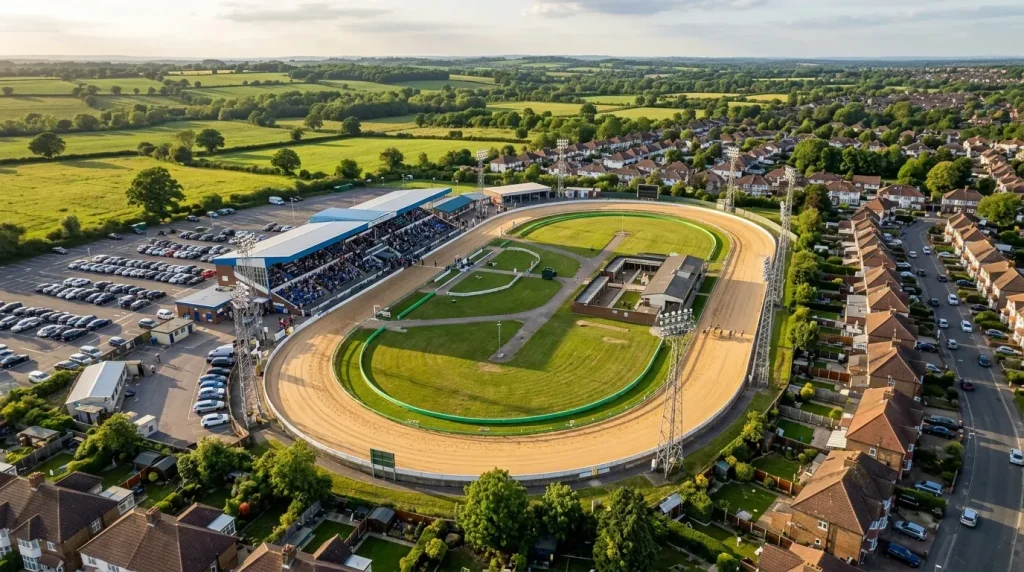
The stadium that reopened in 2022 was recognisably the same Oxford — the Sandy Lane address, the circumference of approximately 397 metres, the distances of 253, 450 and 650 metres — but it was also a modernised venue with upgraded facilities and a management team conscious of the need to attract a new generation of racegoers alongside the loyal core who had waited a decade for the dogs to return. Whether the ten-year lease turns into a longer commitment will depend on factors beyond the track itself — planning decisions, commercial viability and the broader health of UK greyhound racing. For now, Oxford Stadium history has a new chapter, and it is still being written.