Oxford Greyhound Trial Results — How Trials Work and What They Mean
Best Greyhound Betting Sites – Bet on Greyhounds in 2026
Loading...
Oxford trial results rarely make headlines, but they are the gateway to every racing career at the stadium. Before a greyhound can compete in a graded race at Oxford, it must first complete a trial — a non-betting run observed by the racing manager, which determines the dog’s initial grade, distance suitability and trap assignment. No trial, no racecard entry. It is that simple.
For punters, Oxford greyhound trial results are an early signal. A dog that posts a fast trial time over 450 metres is likely to appear on a racecard within days, and knowing what that trial time means — relative to the current graded field — gives you an edge before the market has even formed an opinion. Trials also reveal how a dog handles Oxford’s specific characteristics: the sand surface, the 397-metre circumference, the tight bends. A strong trial at another track does not guarantee the same performance here, and vice versa.
This guide explains how the trial process works at Oxford, what the times and observations actually tell you, and where to find the results before the rest of the market catches up.
How Greyhound Trials Work at Oxford Stadium
The trial process at Oxford follows the standard GBGB regulatory framework that applies to all licensed tracks in the UK. A trainer or owner requests a trial slot for a greyhound — typically a dog new to the track, returning from injury or switching from another venue. The request goes through the racing office, and the dog is scheduled for a trial day, which at Oxford usually falls on a Thursday.
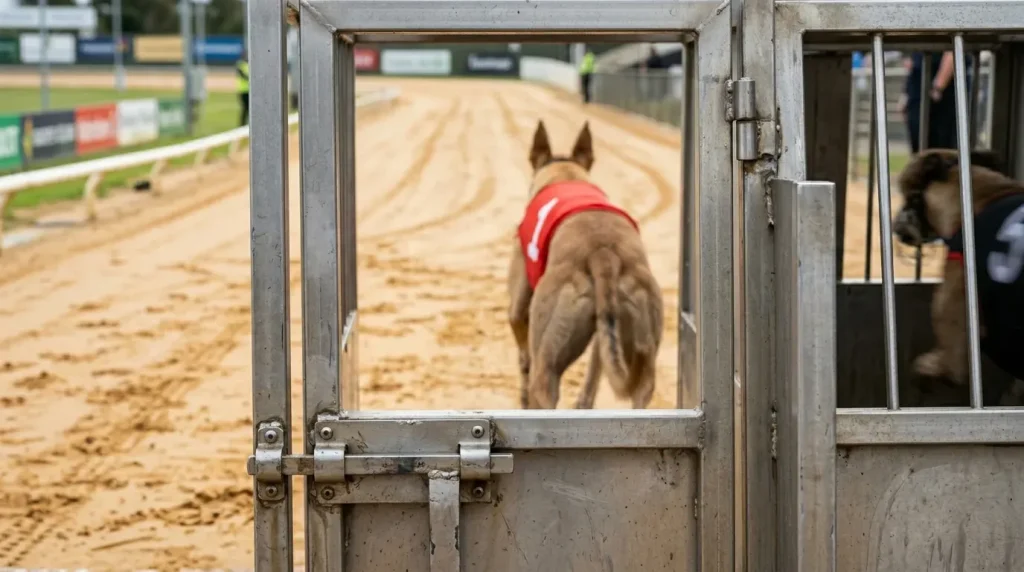
On the day itself, trials take two forms. A solo trial involves a single dog running the course alone, without competition. The purpose is purely to record a time and observe how the dog handles the track — its break from the traps, its behaviour on the bends and its running style over the distance. A competition trial puts two or more dogs on the track together, which gives the racing manager a better sense of how the greyhound will perform in the crowded, contact-heavy environment of a real race.
The racing manager watches each trial and records the time, the trap used and notes on the dog’s performance. Based on this information, the dog is assigned an initial grade — a classification that determines the level of competition it will face in its first racecard appearance. A fast trial time from a dog that breaks cleanly and handles the bends well will earn a higher grade. A slower time or a rough run through the bends will result in a lower grade, which is not necessarily a bad thing — it means the dog will face weaker opposition in its early races, giving it a chance to build confidence.
The UK’s registered greyhound sector includes approximately 500 licensed trainers, with around 6,000 new greyhounds registered each year across all GBGB tracks. Oxford handles a fraction of that total, but the pipeline is steady — new dogs trial at the stadium throughout the year, and the flow of trial results feeds directly into the racecard composition for upcoming meetings.
Welfare considerations are embedded in the trial process. A dog that shows signs of distress, injury or unsuitability for racing during a trial will not be graded. The racing manager has the authority to recommend further veterinary assessment before the dog is cleared to race. This gatekeeping role is taken seriously at Oxford, where the management has made welfare a visible priority since the stadium’s reopening in 2022.
Reading Oxford Trial Results — What the Times Mean
A trial result at Oxford typically includes the dog’s name, the distance trialled, the trap used, the finishing time and brief notes from the racing manager. The time is the number that most people focus on, but interpreting it correctly requires context.
Solo trial times tend to be slower than race times over the same distance. A dog running alone does not have the competitive stimulus of other greyhounds alongside it, and many dogs simply do not run at full effort without that stimulus. A solo trial time of 28.0 seconds over 450 metres does not mean the dog is a 28-second racer — it means the dog is capable of at least that speed under low-pressure conditions and will likely run faster in competition. As a rough benchmark, adding half a second to a solo trial time gives you a more realistic race-time estimate, though individual dogs vary.
Competition trial times are closer to genuine race pace, because the presence of other dogs triggers the chase instinct. A competition trial time of 27.3 seconds at Oxford can be taken more or less at face value — it is a reasonable indicator of what the dog will run in a graded race. Compare that number to the current track benchmarks: the 450-metre record is 26.47 seconds, a strong graded winner typically finishes between 27.0 and 27.5 seconds, and the average field runs somewhere around 27.5 to 28.5 seconds. A trial time in the lower end of that range suggests a dog that will be competitive from its first racecard appearance.
The trap assignment from the trial also matters. If a dog trialled from trap 3 and ran a fast time with a clean bend, it may be assigned that same trap — or a similar inside draw — for its opening race. If it trialled from trap 5 and struggled with the bend, the racing manager might try it from a different position. These nuances are invisible in the bare time but can be gleaned from the notes that accompany trial results, where available.
Distance suitability is another signal embedded in trial data. A dog that trials over both 253 metres and 450 metres in the same session gives the racing manager a clear picture of its speed profile. A quick sprint time paired with a fading 450-metre effort marks the dog as a probable sprint specialist. A moderate sprint time paired with a strong, sustained 450-metre run suggests a standard-distance dog that will improve with competitive racing.
Where Oxford Trial Results Are Published
Trial results are not broadcast with the same fanfare as race results. There is no SIS feed, no live streaming, no bookmaker coverage. Trials are internal events, and the results filter out through narrower channels — which is precisely why knowing where to look gives you an advantage.
Oxford Stadium’s own communications are the primary source. The racing office records every trial and the results are shared with trainers and owners directly. Some of this information reaches the public through the stadium’s social media accounts, where notable trial performances — particularly from high-profile dogs arriving from other tracks — are occasionally highlighted. It is not a systematic feed, but it is worth monitoring if you follow Oxford racing closely.
GBGB maintains records of all trials at licensed tracks as part of its regulatory oversight. While individual trial results are not always published on the GBGB website in the same format as race results, the data feeds into the grading system and becomes visible when a dog’s first racecard entry appears. At that point, the racecard will show the dog’s trial time in its form line — marked distinctly from race results — which tells you the dog is making its Oxford debut.
Greyhound forums and community groups are another informal channel. Dedicated followers of Oxford racing often share trial observations and results in online communities. The quality of this information varies, but experienced contributors tend to be reliable, and their comments can add context that the bare numbers do not provide — how a dog looked physically, whether it appeared comfortable on the track, whether the trial conditions were representative.
As Oxford’s racing manager Kiaran O’Brien put it when he joined the stadium ahead of its reopening: greyhound welfare will always be the biggest priority at Oxford, and greyhounds are the true stars of the sport. That ethos extends to the trial process — every dog that trials at Oxford is assessed not just for its racing ability but for its suitability to the environment. The trial results, when you find them, reflect that dual purpose.