
Oxford Greyhound Track Distances — 253m, 450m and 650m Explained
Best Greyhound Betting Sites – Bet on Greyhounds in 2026
Loading...
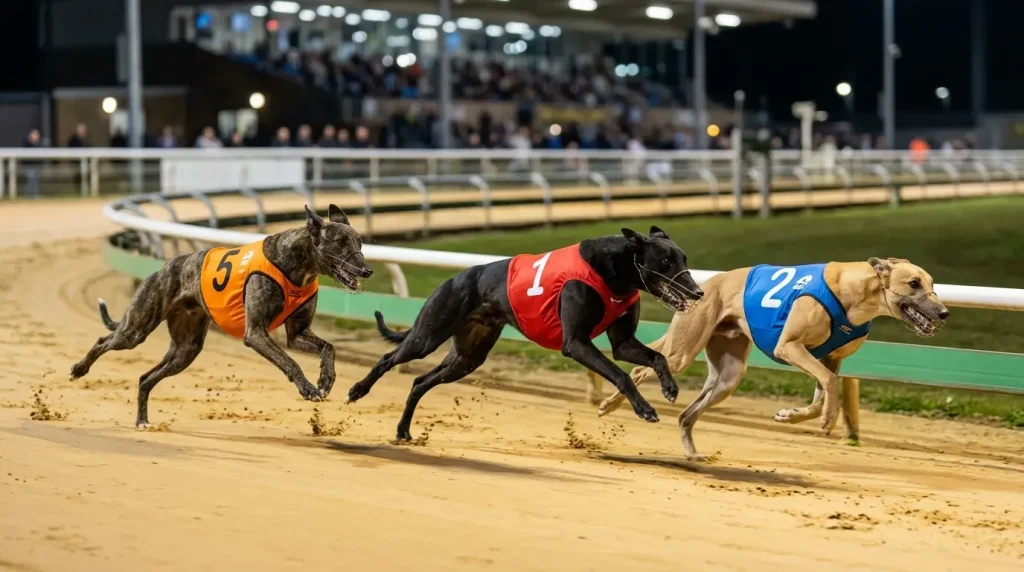
Oxford track distances shape everything about a race — the trap draw, the running style, the pace of the first bend and the type of dog likely to win. The stadium offers three trips: 253 metres, 450 metres and 650 metres. Each demands different qualities from the greyhound, produces different form patterns and requires a different approach from anyone trying to find the winner.
Understanding these distances is not optional if you are serious about Oxford. A dog that dominates over 253 metres may be completely unsuited to the 450-metre trip, and a 650-metre specialist often lacks the raw speed to compete at shorter distances. The racecard tells you the distance; what it does not tell you is how that distance interacts with trap position, track geometry and the specific characteristics of Oxford’s 397-metre circumference sand track. That is what this guide covers.
The 253m Sprint — Oxford’s Shortest and Most Explosive Race
The 253-metre sprint at Oxford is a one-bend dash that lasts roughly 15 seconds. There is almost no time for a slow starter to recover, no opportunity for a closer to run down the leader from the back, and very little margin for error. The race is decided in the first 50 metres — from the traps to the entry of the bend — and everything after that is largely a formality.
This is where trap position matters most. The inside traps (1 and 2) have a shorter path to the bend but can get squeezed by dogs breaking sharply from the middle. The wide traps (5 and 6) have more room to manoeuvre but need to find the rail quickly. At Oxford, trap 5 holds an outsized advantage in graded racing across all distances, and that bias is amplified over 253 metres because the first bend determines the entire race.
The current 253-metre track record is 14.85 seconds, set by Jazzy George in an OR2 race on 7 March 2026. To put that in context, a competitive graded sprint usually finishes somewhere between 15.2 and 15.8 seconds. Any dog breaking 15 seconds is running at or near open-race level, and times below 15.2 generally indicate a dog that is sharp enough to contest higher grades.
Sprint form is volatile. A dog that wins by five lengths one week can finish fourth the next if it stumbles out of the traps or gets bumped at the bend. This makes the 253-metre trip both exciting to watch and difficult to assess from form figures alone. A string of inconsistent results — 1, 4, 1, 5 — does not necessarily indicate an unreliable dog; it often reflects the fine margins of sprint racing, where a fraction of a second at the break changes everything.
The Sandy Lane Sprint, Oxford’s flagship open race, is run over this distance. It was originally announced as a Category One event for 2026 — one of four sprint competitions at the highest level in the GBGB calendar — though the 2026 running is being staged as a Category Two competition. Either way, the designation brings strong sprinters to Oxford and gives the 253-metre trip a profile it has rarely had before.
The 450m Standard — The Most Common Distance at Oxford
The 450-metre trip is Oxford’s bread and butter. The majority of races on any given card — BAGS or evening — are run over this distance, and it is where the stadium produces its deepest form database. Two bends, a back straight and a run to the line: it demands a combination of early speed, bend craft and the stamina to sustain effort over roughly 27 seconds of racing.
The track record at 450 metres is 26.47 seconds, held by Alright Twinkle since 7 February 2026. A typical graded 450-metre race at Oxford finishes between 27.0 and 28.5 seconds depending on the grade and going. Dogs running consistently below 27.5 are operating at a high level; those above 28.0 are generally in the lower grades or struggling with the conditions.
What makes the 450-metre trip tactically interesting at Oxford is the interplay between early pace and bend positioning. A front-running dog that leads through the first bend has a significant advantage, but the second bend — roughly 250 metres into the race — gives closers a chance to make up ground if the leader drifts wide. Oxford’s circumference of 397 metres means the bends are relatively tight, and dogs that rail well gain a measurable advantage over those that run wide.
Trap bias over 450 metres follows the same general pattern as the overall statistics — trap 5 leads, trap 6 trails — but the effect is slightly moderated compared to the sprint. Over two bends, there are more opportunities for positional changes, and a dog drawn in trap 2 or 3 that breaks cleanly has a viable route to the front. Form readers should pay particular attention to a dog’s first-bend sectional time at this distance: a fast split in the opening 50 metres usually translates into a strong finishing position, regardless of trap draw.
For betting purposes, the 450-metre trip offers the most consistent form patterns. Because it is the standard distance, most dogs have multiple runs over it, which makes time comparisons and form lines more reliable than at either the sprint or the staying trip. If you are building a systematic approach to Oxford betting, this is the distance where the data works hardest in your favour.
The 650m Staying Trip — Oxford’s Test of Stamina
The 650-metre race at Oxford covers three or more bends and takes approximately 39 seconds to run. It is a different sport from the sprint. Raw speed matters less; stamina, pacing and the ability to negotiate multiple bends without losing ground matter more. The dogs that win over this distance tend to be rangier, with longer strides and the composure to settle into a rhythm rather than burning out in the first 200 metres.
The track record over 650 metres is 39.09 seconds, set by Eagles Respect in an open race on 25 January 2026. This is also the distance used for the bet365 Hunt Cup, one of Oxford’s most prestigious open events. The Hunt Cup attracts high-grade stayers from across the country, and the winners typically clock times well below 40 seconds.
Trap bias softens considerably at 650 metres. Over three bends, there are enough positional changes that the starting trap becomes less deterministic than at shorter distances. A dog drawn in trap 6 has more time and space to find a good racing position, and the extended distance rewards dogs that can sustain speed rather than those that simply break fastest. This does not mean the trap draw is irrelevant — trap 5 still benefits from the first-bend geometry — but the margin of advantage is smaller, and form and class tend to assert themselves more decisively.
Staying races are less common on the Oxford card than the 450-metre standard, which means the form sample for individual dogs at this distance can be limited. A dog with only two or three runs over 650 metres is harder to assess than one with a dozen 450-metre efforts. When the form is thin, pay extra attention to breeding — some bloodlines are known stayers — and to how the dog finishes its 450-metre races. A dog that is still running on strongly at the line over 450 metres is a natural candidate to improve over the staying trip.
Distance Preferences — How to Spot a Distance Specialist
The racecard gives you a dog’s recent form, but it does not always make the distance context obvious. A form line of 3, 2, 1 looks impressive until you realise those runs were all over 253 metres and the dog is now stepping up to 450 metres for the first time. The skills do not transfer automatically.
Sprint specialists are typically compact, fast-twitch dogs that break explosively from the traps and hold their speed through a single bend. They tend to have form lines littered with ones and twos at 253 metres but erratic results — fives and sixes — when tried over 450 metres. If a dog has been consistently placed over the sprint and is now running a standard race, be cautious. Speed alone is not enough when there are two bends to negotiate.
Stayers show the opposite profile. Their 253-metre form is often poor because they lack the early pace to be competitive in a one-bend dash, but their 450-metre and 650-metre efforts reveal a pattern of finishing strongly. Look for dogs that routinely close ground in the second half of a 450-metre race — they are the natural candidates for improvement over 650 metres.
The most versatile dogs at Oxford are those that compete effectively over both 253 and 450 metres. These are rare but valuable to identify, because they tend to be genuinely talented rather than distance-dependent. Their form is consistent across trips, their times are competitive at both distances, and they handle Oxford’s bends with equal comfort whether they are navigating one or two.
When studying the Oxford racecard, always check which distance a dog’s recent form was achieved over. A time of 27.3 at 450 metres tells you something useful. A time of 15.1 at 253 metres tells you something completely different. Mixing the two without context is a recipe for bad selections.