
Going Reports in Greyhound Racing — How Weather Affects Oxford Results
Best Greyhound Betting Sites – Bet on Greyhounds in 2026
Loading...
The going report is one of the most overlooked factors in greyhound form analysis, and at Oxford it may be the most underrated. Nine out of ten competitors in the search results for Oxford greyhound data do not mention track conditions at all — which means the punters who do pay attention to the going hold an informational edge that the market has not priced in.
Going describes the condition of the track surface at the time of racing: how firm or soft it is, how much grip it provides, how fast or slow the dogs can run. At Oxford, where the surface is sand and the weather in Oxfordshire is characteristically British — meaning it rains often and unpredictably — the going can shift between meetings, within a meeting and sometimes between races. A dog’s time of 27.2 seconds on a Tuesday morning means something different on fast going than it does on slow, and ignoring that distinction is one of the most common mistakes in greyhound form study.
Oxford’s Sand Surface — How It Responds to Conditions
Oxford Stadium runs on a sand surface, which is the most common track material in UK greyhound racing. According to the stadium’s Wikipedia entry, the track has a circumference of approximately 397 metres and was resurfaced as part of the £1.8 million refurbishment that preceded the 2022 reopening. The sand surface was laid fresh, which means all going data from the modern era reflects a consistent base material.
Sand tracks respond to weather in predictable but significant ways. In dry conditions, the surface firms up, providing good grip and fast running. Dogs can accelerate cleanly out of the traps, hold their speed through the bends and produce times at or near their best. This is typically described as “fast” or “standard” going, and it is the baseline against which all Oxford times should be measured.
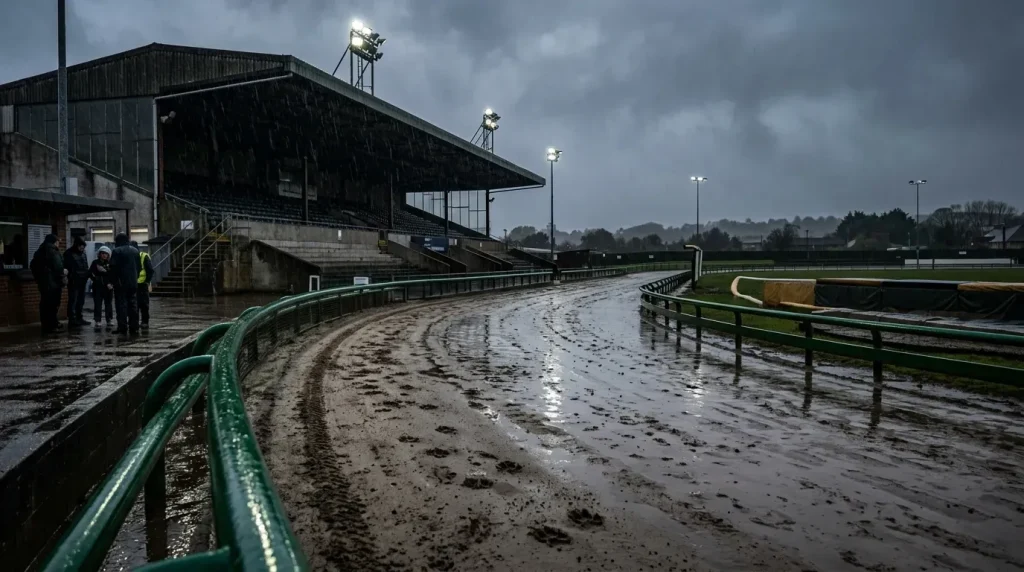
Rain changes the picture. Water softens the sand, reducing grip and increasing the energy required to maintain speed. The going description shifts from “standard” to “slow” as the moisture content rises, and in heavy or prolonged rain it can reach “heavy” — a condition where times are significantly slower and the racing dynamics change noticeably. A dog that runs 27.0 seconds on fast going might clock 27.8 or worse on heavy, not because it has lost ability but because the surface is absorbing more energy with every stride.
Sand drains better than some alternatives, which means the going at Oxford can recover relatively quickly after rain. A morning shower might produce slow going for the first few races of an evening card, with the surface drying and firming as the meeting progresses. Punters who are aware of this progression can factor it into their assessments: a dog racing in the first race on a drying track faces different conditions from one racing in the tenth.
The alternative surface used at some UK tracks is polytrack — a synthetic material that is less affected by weather. Tracks running on polytrack tend to produce more consistent times across different conditions, which makes form comparison easier. Oxford’s sand surface, by contrast, introduces a variable that requires active management from the form analyst. It is not a disadvantage — it is an opportunity, because the extra variable creates more room for mispricing in the betting markets.
Fast vs Slow Going — The Impact on Race Times
The practical question for any punter studying Oxford form is: how much does the going affect the time? The answer varies by distance, but as a working rule, the difference between fast going and slow going at Oxford is typically 0.5 to 1.0 seconds over the standard 450-metre trip. On heavy going, the difference can exceed a full second.
The current 450-metre track record of 26.47 seconds was set on what is presumed to be fast or standard going — the kind of firm surface that produces the quickest times. A competitive graded race on the same going might finish around 27.0 to 27.5 seconds. Shift the going to slow, and those times stretch to 27.5 to 28.5 seconds. On heavy going, even good dogs can run above 28.0 seconds without it reflecting any loss of form.
Over the 253-metre sprint, the going effect is proportionally smaller — perhaps 0.2 to 0.5 seconds — but in a race that lasts 15 seconds, even a fraction matters. A dog clocking 15.3 on slow going might be running the equivalent of 14.9 or 15.0 on fast, which would make it competitive at a level its raw time does not suggest.
Calculated time is the analytical tool that addresses this problem. Platforms like Greyhound Stats UK and Timeform adjust raw times for going, producing a normalised figure that represents what the dog would have run under standard conditions. These calculated times are more reliable than raw times for comparing performances across different meetings. If you are doing form study for Oxford and not using calculated times, you are working with an incomplete picture — particularly during the wetter months when going variations are at their most extreme.
The habit of checking the going report before studying a result adds about ten seconds to your form routine and changes the quality of every conclusion you draw. It is the single easiest improvement most punters can make to their Oxford form analysis.
How Weather Shifts Trap Bias at Oxford
Oxford’s trap bias — trap 5 winning 23.5% of graded races overall — is a dry-weather statistic. When the going changes, the bias shifts, and punters who assume the standard numbers still apply in the rain are working with outdated information.
The mechanism is physical. On a firm surface, all six traps provide roughly equal grip at the break, and the advantage flows to trap 5 because of its geometric position relative to the first bend. On a soft surface, the inside traps — particularly traps 1 and 2 — can lose grip more quickly, because the inside of the track tends to hold more water (it is lower, it drains more slowly, and it receives less wind). This grip differential gives the outside traps an even greater advantage in wet conditions, potentially amplifying the trap 5 bias beyond its dry-weather level.
Conversely, there are conditions where the inside track firms up faster — after a brief shower followed by sunshine, for example — and the standard bias reasserts or even reverses slightly as the inside becomes the faster line. These shifts are subtle and not always visible in the aggregate statistics, which average across all conditions. But on any given race day, the going report provides a clue about which direction the bias is likely to lean.
The practical approach is straightforward. Check the going before the meeting. If it is fast or standard, use the standard trap bias data as your baseline. If it is slow or heavy, weight the outside traps more heavily and be cautious about inside-drawn dogs whose recent form was achieved on faster going. And if the going is changing during the meeting — which happens more often than most punters realise — adjust your assessments race by race rather than applying a single bias assumption to the entire card.