UK Greyhound Racing in Numbers — Industry Size, Tracks and Attendance
Best Greyhound Betting Sites – Bet on Greyhounds in 2026
Loading...
UK greyhound racing is an industry that generates £55 million in annual economic contribution, operates across 18 licensed stadiums and attracts more than two million visits per year. Those headline figures describe a sport that, while smaller than it once was, remains a significant part of the British sporting and betting landscape. Oxford Stadium, as one of the 18 licensed venues, sits within this ecosystem — shaped by its economics, governed by its regulations and sustained by its betting turnover.
But headline numbers alone do not capture the full picture. Behind the aggregate statistics are trends that tell a more complex story: a shrinking track network, a declining workforce pipeline, a betting market under pressure and an industry navigating political challenges from the Wales ban to the levy debate. This guide presents the key data points, puts them in historical context and explains what they mean for the sport’s trajectory.
The Sport Today — 18 Tracks, 500 Trainers, 2 Million Fans
The UK’s licensed greyhound racing sector currently comprises 18 GBGB-licensed stadiums spread across England and Wales. Scotland has no active licensed tracks, and Wales has one — Valley Stadium in Ystrad Mynach — which faces closure under the Welsh Government’s ban. The 18 tracks are concentrated in England, with clusters in London and the southeast (Romford, Crayford), the Midlands (Monmore Green, Perry Barr, Nottingham) and various standalone venues including Oxford, Hove, Sunderland and Yarmouth.
The human infrastructure behind the sport is substantial. Approximately 500 licensed trainers operate across the UK, each managing kennels that house, feed, exercise and prepare racing greyhounds. Around 3,000 kennel staff support these operations, handling the day-to-day care of the dogs. A further 700 track officials — stipendiary stewards, racing managers, veterinarians, grading secretaries — ensure that meetings run according to GBGB rules. Behind the scenes, an estimated 15,000 individuals are registered as greyhound owners, ranging from individuals who own a single dog to syndicates and professional operations.
New greyhound registrations run at approximately 6,000 per year, feeding the pipeline of dogs that enter racing, move through the grading system and eventually retire. This number has declined — GBGB registered 5,899 new greyhounds in 2023, a 19% drop from 2019 levels — reflecting both the contraction of the track network and a broader reduction in the breeding and supply chain.
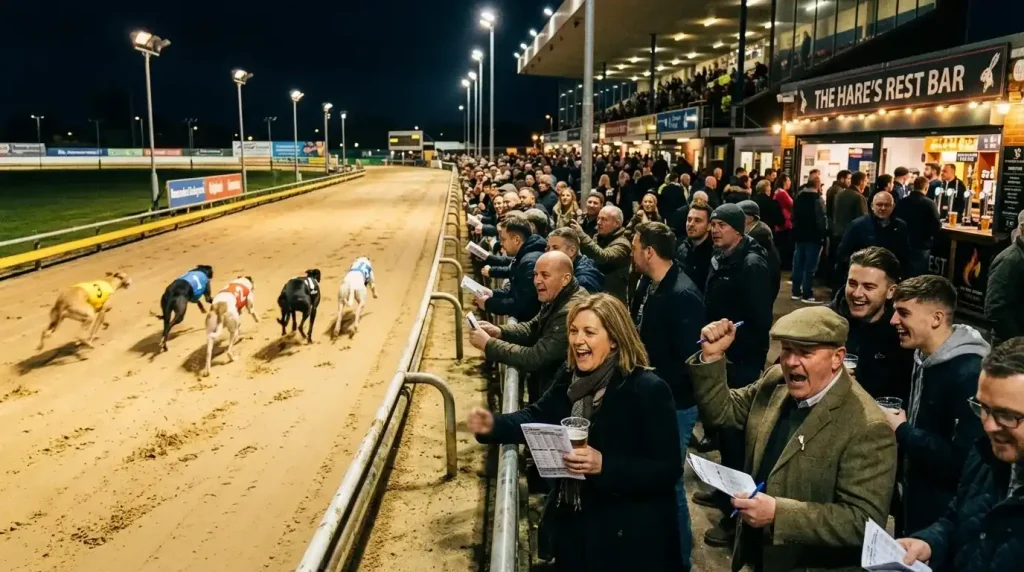
Attendance at UK greyhound tracks exceeds two million visits annually, though this figure includes repeat visitors and does not represent unique individuals. The audience skews older and more male than the general population, with a core of regular racegoers supplemented by casual visitors — corporate groups, stag parties, families on evening outings — who attend for the social experience rather than the betting. Oxford’s reopening in 2022, with its SAVANA restaurant and modernised facilities, was explicitly designed to attract this broader audience alongside the betting regulars.
Compared to horse racing, these numbers are modest. But within the UK’s sporting ecosystem, greyhound racing retains a meaningful footprint — particularly in betting shops, where BAGS content fills screens for hours every day, and among the communities where individual tracks serve as social and entertainment hubs.
Economic Contribution — £55 Million and 7,000 Jobs
GBGB data puts the sport’s total economic contribution at £55 million per year, supporting more than 7,000 jobs across the UK. That figure encompasses direct employment at tracks, kennel operations, veterinary services, SIS broadcasting, BGRF administration and the ancillary businesses — catering, security, groundskeeping — that depend on racing for their revenue.
Prize money is a separate metric that tracks the competitive health of the sport. Total prize money across all GBGB-licensed tracks reached £15.7 million in the most recent reported year. This is distributed across thousands of races, from BAGS morning cards where prizes are modest to Category One events like the English Greyhound Derby, where the winner receives £175,000. The prize money distribution reflects the sport’s structure: the majority goes to graded racing, the shop window events capture the headlines, and the gap between the top and the bottom is wide.
The £55 million economic contribution figure, while significant, should be understood in context. It represents a fraction of what the industry generated at its peak, and it is dwarfed by the economic contribution of horse racing, which the British Horseracing Authority estimates at over £4 billion. Greyhound racing operates at a different scale — smaller venues, smaller crowds, smaller betting pools — and its economic footprint is concentrated in specific communities rather than spread nationally.
For Oxford, the economic contribution is local but tangible. The stadium employs staff directly, supports trainers and kennel operations in the surrounding counties, generates betting turnover through its BAGS schedule and brings visitors to the area on evening race nights. The SAVANA restaurant alone seats 180 guests, and full houses on Friday and Saturday evenings represent a meaningful injection of spending into the local hospitality economy. The broader supply chain — feed merchants, veterinary practices, transport operators — also benefits from Oxford’s five-day racing week, even if their dependence on the stadium is not always visible in the aggregate industry figures.
From 77 Tracks to 18 — The Long Decline
The numbers in 2026 need to be read against the backdrop of what the sport once was. In the 1940s, the UK had 77 licensed greyhound tracks and over 200 unlicensed flapping venues. Combined attendance rivalled football, and greyhound racing was one of the most popular spectator sports in the country. The decline from that peak to today’s 18 tracks is one of the most dramatic contractions in British sporting history.
The drivers of that decline are multiple. Television reduced the appeal of live attendance at all sporting venues, but greyhound tracks — which lacked the atmosphere and facilities of major football grounds — were hit disproportionately. The legalisation of betting shops in 1961 moved wagering off-course, reducing the revenue that tracks earned from on-course betting. Property development absorbed dozens of stadium sites, particularly in London and the major cities, where land values made it impossible for greyhound racing to compete with residential or commercial use.
The BAGS system, launched in 1967, saved some tracks by providing a new revenue stream, but it also changed the nature of the sport. Tracks that survived the cull tended to be those with BAGS contracts, which meant the sport became increasingly dependent on bookmaker funding rather than public attendance. The tracks that could not secure contracts — or that sat on land too valuable to resist development offers — closed, one by one, through the 1970s, 1980s, 1990s and 2000s.
As GBGB’s outgoing CEO Mark Bird acknowledged, UK greyhound racing is better placed to enter its second centenary than it was a decade ago, but complacency is not an option. The sport’s social licence — its permission to operate within society’s evolving expectations around animal welfare and entertainment — depends on continued improvement. The 18 tracks that remain in 2026 are the survivors of an 80-year contraction, and their future depends on the industry’s ability to adapt to a landscape that is still shifting.