100 Years of Greyhound Racing — The 2026 Centenary and Its Significance
Best Greyhound Betting Sites – Bet on Greyhounds in 2026
Loading...
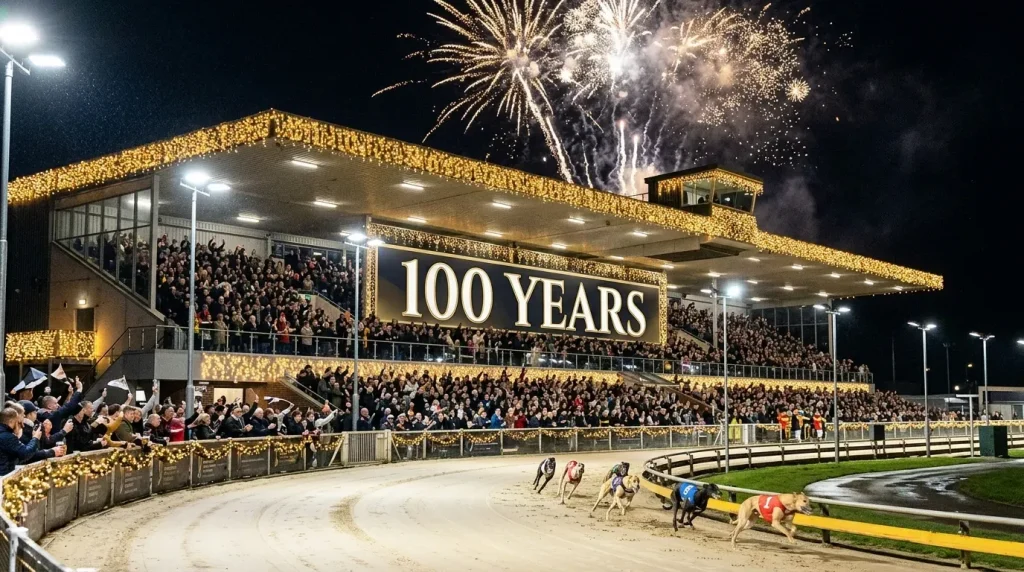
On 24 July 2026, greyhound racing in Britain turns 100. One century ago, a greyhound named Mistley won the first official race at Belle Vue Stadium in Manchester, covering 440 yards in 25.00 seconds in front of a crowd that had no idea it was witnessing the birth of a national sporting institution. The greyhound racing centenary is both a celebration and a reckoning — a moment to honour a sport that once rivalled football for crowds, and to confront the reality that its second century begins from a far smaller base than its first.
GBGB has built a programme of events around the anniversary, from gala dinners to an expanded racing calendar. Oxford Stadium, revived in 2022 after a decade of closure, has a particular role in the centenary narrative: it represents the possibility of renewal at a time when most of the sport’s story has been about contraction. This guide covers the history of that first race, the century of transformation that followed and the events planned for 2026.
Belle Vue, 24 July 1926 — The Race That Started It All
The concept of mechanical hare greyhound racing was imported from the United States, where it had been developed as an alternative to the live coursing that was already controversial in the early twentieth century. An American promoter, Charles Munn, brought the idea to Britain along with a group of investors who saw the commercial potential of combining greyhound speed with a stadium setting and organised betting.
Belle Vue Stadium in Manchester was the venue, and 24 July 1926 was the date. The first race was run over 440 yards — the imperial equivalent of approximately 400 metres — and the winner was a greyhound named Mistley, clocking 25.00 seconds. The crowd was substantial for a sporting novelty, and the reaction was immediate: this was fast, exciting and easy to bet on. Within months, other stadiums across England were converting or being built to host greyhound racing.
The speed of adoption was remarkable. By the end of 1927, greyhound tracks were operating in London, Birmingham, Edinburgh and a dozen other cities. By the 1930s, the sport had become a mass entertainment phenomenon, drawing working-class crowds who could not afford regular football tickets but could spend an evening at the dogs for a few shillings. The combination of spectacle, social atmosphere and the opportunity to gamble — legal on-course, unlike off-course betting which remained illegal until 1961 — gave greyhound racing a unique appeal that no other sport could replicate.
Oxford Stadium entered the story in 1939, thirteen years after that first race at Belle Vue. By then, the sport was established, regulated by the National Greyhound Racing Club, and drawing crowds that made it one of the most attended spectator sports in Britain. The Belle Vue legacy was already woven into the fabric of British working-class culture, and tracks like Oxford were its regional expression.
A Century of Transformation — From Post-War Boom to Modern Sport
The century between 1926 and 2026 divides into roughly four eras, each defined by a different relationship between the sport, its audience and its economics.
The first era, from the 1920s through the 1950s, was the boom. At its peak in the late 1940s, Britain had 77 licensed tracks and over 200 unlicensed flapping venues. Attendance was enormous — the sport drew an estimated 50 million visits per year in its best seasons, second only to football among spectator sports. The greyhound stadium was a community hub: a place to socialise, drink, eat and gamble, often within walking distance of home. This was the era that built the tracks, established the traditions and created the culture that the sport still trades on.
The second era, from the 1960s through the 1980s, was the transition. Television, car ownership and the legalisation of betting shops transformed how people spent their leisure time and their gambling money. Live attendance declined, and many tracks — unable to compete for land with property developers offering millions for stadium sites — closed permanently. The BAGS system, launched in 1967, provided a financial lifeline for surviving tracks by creating a bookmaker-funded content model. Oxford was one of the first four BAGS venues.
The third era, from the 1990s through the 2010s, was the contraction. Track closures accelerated, attendance fell further, and the sport’s public profile diminished. Welfare controversies drew negative media attention, and the political environment became less sympathetic. Oxford closed in 2012 as part of this wave. By the time the decade ended, the 77 tracks of the 1940s had become 20, and the sport felt to many observers like a relic being managed toward extinction.
The fourth era — the present — is harder to characterise, because it is still unfolding. Oxford’s reopening in 2022 was a counter-narrative to the decline story. The centenary programme in 2026 is another. Whether the sport’s second century is a slow final act or a genuine renewal will depend on decisions being made now about funding, welfare, political engagement and the ability to attract a younger audience.
Celebrating 2026 — Events, Category One Races and the Gala Dinner
GBGB’s centenary programme is designed to generate positive coverage, energise the sport’s core audience and demonstrate to politicians and the public that greyhound racing has a future as well as a past. The centrepiece is a gala dinner at Dunstall Park, featuring a recreation of the first race to honour the Belle Vue legacy and the century of racing that followed.
The competitive calendar has been expanded to match the occasion. The 2026 GBGB schedule includes 50 Category One events and 27 Category Two events across all licensed tracks — the most comprehensive open-race programme in recent memory. GBGB Racing Operations Executive Louise Warr has described 2026 as an exciting year for the sport, with a whole host of events taking place both on and off the track to celebrate 100 years.
Oxford benefits directly from this expanded calendar. The Sandy Lane Sprint — the stadium’s signature race, run over 253 metres — was elevated to Category One status for 2026, making it one of only four sprint events at the highest level in the GBGB calendar. This is a significant upgrade for Oxford, bringing elite-level competition to a track that was closed entirely just four years ago. The elevation also means increased prize money, wider media coverage and stronger fields, all of which raise the stadium’s profile within the sport.
Beyond the flagship events, the centenary programme includes heritage exhibitions, community engagement projects and a media campaign that tells the sport’s story through the stadiums and people that have shaped it. Oxford, as a venue that closed and came back, is a natural focal point for the revival narrative. Whether that narrative translates into sustained growth — rather than a one-year celebration followed by a return to decline — is the question the industry cannot yet answer.
The centenary is also, inevitably, a political tool. In the shadow of the Wales ban and the ongoing welfare debate, GBGB is using the anniversary to remind legislators and the public that greyhound racing is a century-old part of British culture, not a recent invention that can be casually discarded. The argument carries emotional weight, even if it does not resolve the substantive policy questions. A hundred years is a long time. What the next hundred look like depends on decisions being made in 2026.