
How Greyhound Grading Works — From A1 to Open Racing
Best Greyhound Betting Sites – Bet on Greyhounds in 2026
Loading...
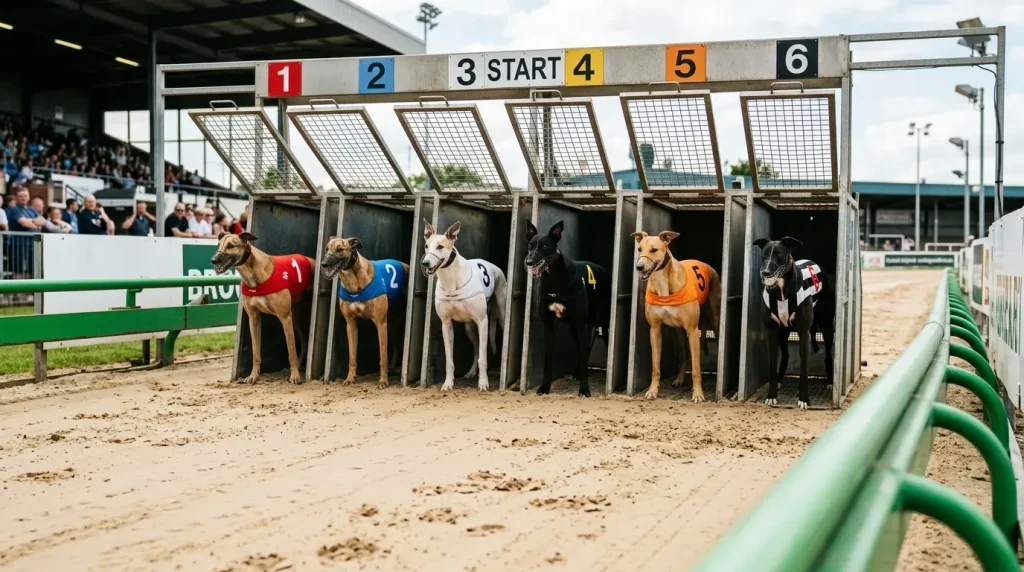
Greyhound grading is the system that determines which dogs race against each other — and understanding it is the key to reading any racecard at Oxford or any other GBGB-licensed track. Every racing greyhound in the UK is assigned a grade based on its performance, and that grade dictates the level of competition it faces. A dog graded A3 runs against other A3 dogs; it does not compete against A1 runners in a regular graded race, nor against A7 dogs that would pose little challenge.
The system exists to produce competitive racing. Without it, the fastest dogs would dominate every card, the slower dogs would never win, and the betting markets would be predictable to the point of irrelevance. Grading ensures that each race features a reasonably matched field, which creates genuine uncertainty in the outcome — the foundation on which the entire betting product is built. Oxford applies the standard GBGB grading framework, and the grades it hosts reflect its position as a mid-tier BAGS track with an active open-race programme.
The A-Grade System — How Greyhounds Are Classified
The GBGB grading system classifies racing greyhounds primarily by their winning times. The A-grade scale runs from A1 — the fastest — down to A10 or lower, depending on the track. Each grade corresponds to a time band over the track’s standard distance, and dogs are placed into the grade that matches their demonstrated ability.
A new greyhound entering the racing system receives its initial grade after completing a trial. The trial time, assessed against the track’s grading bands, determines where the dog starts. A fast trial earns a high grade; a slower trial places the dog lower in the system. From that point, the grade moves based on race performance: winning promotes a dog, consistently finishing out of the places demotes it.
Promotion and demotion follow specific rules. A win typically moves a dog up one grade for its next outing. Two or three poor finishes in succession may trigger a drop. The exact thresholds vary by track and are managed by the grading secretary under GBGB oversight. The goal is to keep dogs in the grade where they are competitive — neither hopelessly outclassed nor running against opposition they can beat without effort.
Beyond the A grades, the system includes D grades for developmental dogs — typically younger or less experienced greyhounds that are not yet ready for graded competition — and puppy grades for dogs under a certain age. These developmental categories serve as a pipeline, feeding dogs into the graded racing programme as they mature and improve. Across all GBGB tracks, approximately 6,000 new greyhounds are registered each year, and each one enters the grading system through this pathway.
The grading system also distinguishes between distances. A dog graded A3 over 450 metres is not automatically A3 over 253 metres. Different distances test different abilities, and a dog’s grade may vary depending on the trip. This is particularly relevant at Oxford, which offers three distances — 253, 450 and 650 metres — each with its own competitive dynamics. A dog that dominates the sprint grades may be mid-pack or worse at the standard distance, and the grading system reflects this by assigning distance-specific classifications where necessary. The result is that a single dog can carry different grades at different distances within the same track — a layer of complexity that the racecard does not always make obvious at first glance.
Grading at Oxford — Which Grades Race at Which Distance
Oxford’s graded racing programme covers a range from approximately A3 through A8, with occasional A2 and A9 races depending on the kennel pool and the card composition. The highest-quality graded runners tend to appear on Friday and Saturday evening cards, while the BAGS cards on Tuesday and Thursday mornings feature a broader spread of grades.
The trap statistics that define Oxford’s racing character — trap 5 winning 23.5% of graded races from a sample of 345 winners — are derived entirely from graded competition. This is an important distinction: the trap bias data applies to races where the field is competitively matched within a grade. Open races, where dogs of different abilities compete without grade restrictions, produce different dynamics and different trap outcomes.
Over the 253-metre sprint, Oxford tends to card lower grades less frequently. The sprint demands a specific skill set — explosive trap speed and clean bending — that not all dogs possess, and the grading secretary typically reserves the distance for dogs that have demonstrated sprint ability in trials or previous races. The 450-metre standard is the workhorse distance, hosting the widest range of grades across the most races per card. The 650-metre staying trip is used selectively, often for higher-grade dogs where stamina testing adds a competitive dimension.
For punters, the practical implication is that not all grades are equally informative. A dog’s form in an A3 race at Oxford carries a different weight from its form in an A7 race, because the quality of opposition — the speed of the rivals, their trap behaviour, their tactical nous — varies significantly across the grading spectrum. A dog winning from trap 5 in A3 company is beating better dogs than one winning from the same trap in A7, even if the raw time is similar.
Open Racing — When the Best Dogs Compete Without Grades
Open races sit outside the grading system entirely. There are no grade restrictions, no time bands, no promotion or demotion. The best dogs in the country — or at least the best available — are invited to compete, and the result depends purely on ability on the night. Category One and Category Two events represent the pinnacle: major competitions with significant prize money, media coverage and prestige.
GBGB Racing Operations Executive Scott Harvey has noted that the open-race calendar is expanding, with a Category One Puppy competition scheduled for every month except January, May and June (when the English Greyhound Derby takes centre stage). This expansion reflects the sport’s effort to create high-profile fixtures that attract attention from casual fans and the media, not just the regular betting audience.
Oxford’s Sandy Lane Sprint, elevated to Category One status in 2026, is the stadium’s flagship open event. Run over 253 metres, it attracts the fastest sprinters from across the country, and the winner claims a title that now carries national significance. The Hunt Cup (650 metres) and Challenge Cup are Oxford’s other notable open events, offering staying and middle-distance tests at the highest level the stadium hosts.
For punters, open races require a different analytical approach than graded racing. The trap bias data that works well for graded races — where the field is evenly matched and the trap draw becomes a decisive variable — is less reliable in open races, where individual class can override statistical tendencies. A genuinely superior dog drawn in trap 6 may win an open race despite the trap disadvantage, because the gap in ability compensates for the geometric disadvantage. In graded racing, that gap does not exist by design.