
How to Read Greyhound Form Figures — A Beginner’s Guide
Best Greyhound Betting Sites – Bet on Greyhounds in 2026
Loading...
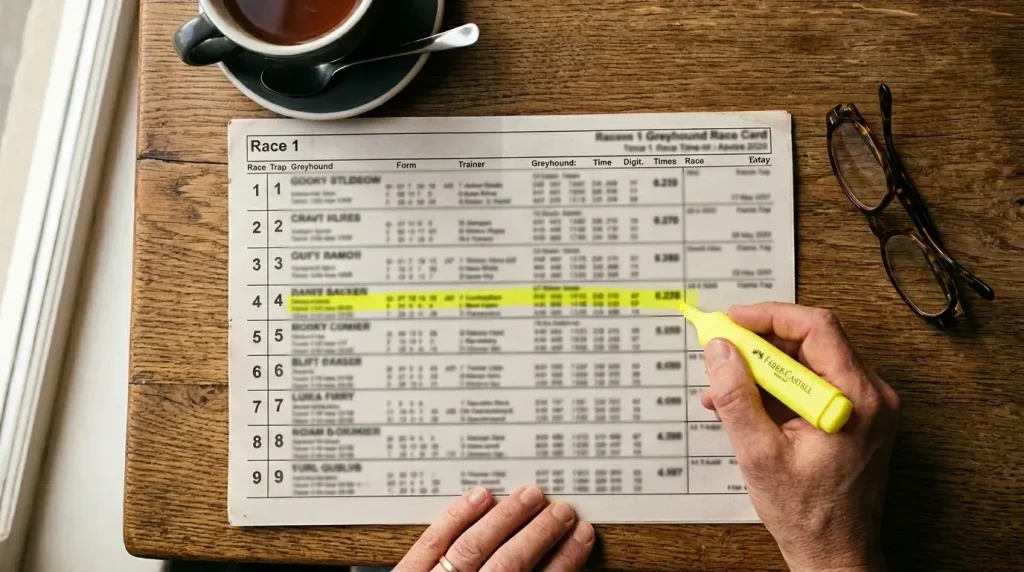
Greyhound form is the compressed history of a dog’s recent racing career, reduced to a string of numbers and letters that tells you more in six characters than most written reports manage in six paragraphs. Every racecard at Oxford — and every other GBGB-licensed track — includes a form line for each runner, and learning to read it is the single most important skill for anyone who wants to bet on the sport with any degree of seriousness.
The system is not complicated, but it is dense. Each digit represents a finishing position from a recent race. Each letter represents a specific incident or running style. Together, they create a shorthand narrative: this dog has been winning, this dog has been struggling, this dog had trouble on the bend three runs ago and has improved since. If you can read greyhound form fluently, you can scan a racecard in minutes and identify the runners worth backing — and the ones worth avoiding.
Numbers 1 to 6 — What Each Position Means
Greyhound racing is a six-dog sport, which means the finishing positions run from 1 (winner) through 6 (last). A form line displays the results of a dog’s most recent races in sequence, with the oldest result on the left and the most recent on the right. A typical form line might read 342151 — six runs, read left to right, telling you the dog finished third, then fourth, then second, then first, then fifth, then first again in its most recent outing.
The most recent figure — the one on the far right — carries the most weight. It is the freshest data point and the closest reflection of the dog’s current ability. A form line ending in 1 tells you the dog won last time out, which is always a positive signal regardless of what came before. A form line ending in 6 means the dog finished last in its most recent race, which demands investigation: was it outclassed, injured, badly drawn or simply outrun?
Pattern recognition is where form reading becomes genuinely useful. A form line of 111111 is self-explanatory — this dog has won six consecutive races and is either about to be promoted to a higher grade or is already the class of its current level. A line of 654321 tells a story of progressive improvement: the dog started at the bottom and has been climbing. A line of 123456 tells the opposite story: a dog in decline, losing form with each run.
At Oxford, where trap 5 wins 23.5% of graded races, the form figures gain additional context from the trap draw. A dog showing 111 from three consecutive runs in trap 5 may be benefiting from the trap advantage rather than demonstrating genuine superiority. The same form from trap 6 — the weakest position statistically — is a much stronger signal, because the dog is winning despite a positional disadvantage. Always cross-reference the form figures with the trap from which they were achieved.
The number of figures displayed varies. Most racecards show the last six runs, but a dog new to a track or returning from a break may have fewer entries. A form line of just two or three figures indicates limited recent data, which increases the uncertainty in your assessment. Dogs with short form lines are harder to evaluate and, consequently, more likely to be mispriced by the market — which can be either a risk or an opportunity, depending on what other information you have.
m, w, d and Other Codes — The Letters Behind the Numbers
Numbers tell you where the dog finished. Letters tell you how it ran. They appear alongside or instead of the numerical position and provide critical context that the bare finishing place cannot convey.
The letter “m” stands for middle running. When appended to a form figure — for example, 3m — it indicates the dog ran in the middle of the pack for most of the race before finishing third. This is useful information because it suggests the dog neither led from the front nor closed from the rear. Middle runners at Oxford can be difficult to assess: they often finish in positions that reflect traffic and crowding on the bends rather than their true ability.
The letter “w” stands for wide. A form entry of 4w tells you the dog ran wide on the bends and finished fourth. At Oxford, running wide is particularly costly because the 397-metre circumference produces relatively tight turns. A dog that loses two or three lengths by running wide on each bend may finish several places below its actual ability level. If you see “w” in recent form, the dog is worth a closer look — it may have been running better than the position suggests, and a cleaner run next time could produce a significantly improved result.
The letter “d” indicates disqualification, typically for interference with another runner. A disqualified dog is placed last regardless of where it actually finished, which means the form figure does not reflect its race performance. If a dog’s most recent form shows “d”, check the race details to understand what happened — a dog that was running first when it was disqualified for bumping is a very different proposition from one that was running last and was disqualified for unrelated reasons.
Other codes include “F” for fell (the dog went down during the race), “T” for trapped (the dog failed to leave the traps cleanly) and various steward-specific annotations that describe incidents during running. These codes are less common but equally important when they appear. A dog that fell two runs ago and has since run twice without incident is likely past the episode; one that has been trapped in two consecutive starts may have a trapping problem that will recur.
The key principle with letter codes is that they add information, not noise. Every letter on a form line is there for a reason, and ignoring them — treating the form as purely numerical — strips away context that could change your assessment of a dog’s actual ability.
Building a Picture — Combining Form With Track Data
Form figures on their own are a starting point, not a conclusion. To build a complete picture of a dog’s chances at Oxford, you need to combine the form with track-specific data: the trap draw, the going report, the distance and the trainer’s record.
Take an example. A dog running in race 5 on a Friday evening at Oxford, drawn in trap 4 over 450 metres, showing form of 231142. The recent form is strong — a win last time, a second the time before, and a consistent run of placed finishes. The 450-metre track record is 26.47 seconds, and this dog’s best recent time is 27.3. That puts it in the competitive range for its grade but not at the top. The trap draw is neutral — trap 4 is neither the strongest nor the weakest at Oxford. The going is reported as standard.
Now add the trainer data. If the trainer has a 22% strike rate at Oxford over the last three months, that is above average and adds confidence to the selection. If the going were slow rather than standard, you might check whether this dog has run well on soft surfaces previously. If the trap draw were trap 5 instead of trap 4, you would factor in the 23.5% win rate and adjust your probability upward.
The form figures started the analysis. The track data completed it. Neither alone is sufficient — but together, they give you a rational basis for deciding whether to back this dog, oppose it or move on to the next race. That integration of form and context is what separates consistent punters from those who bet on instinct and hope for the best.