
Oxford Greyhound Betting Odds — How Prices Are Formed and Where to Find Value
Best Greyhound Betting Sites – Bet on Greyhounds in 2026
Loading...
Oxford betting odds are not created equal. The price you see on a BAGS morning card at 10:32 on a Thursday is formed differently, by different mechanisms, than the price available on a Friday evening open race night. Understanding that difference — and knowing which pricing method works in your favour — is a fundamental skill for anyone betting regularly on Oxford greyhound racing.
The UK greyhound betting market is substantial. Odds formation at Oxford sits within this ecosystem, shaped by the bookmaker margin, the volume of money in the market and the quality of information available to the price-setters. Most punters take the price they are offered without questioning where it came from. The ones who do question it — who understand how Oxford betting odds are constructed and where the inefficiencies hide — are the ones who find value consistently.
How Starting Prices Work at Oxford — From Morning Line to SP
The starting price (SP) is the official odds at which a bet is settled if you take the SP option rather than a fixed price. At Oxford, the SP formation process differs depending on the type of meeting, and understanding those differences is essential to evaluating whether a price represents value.
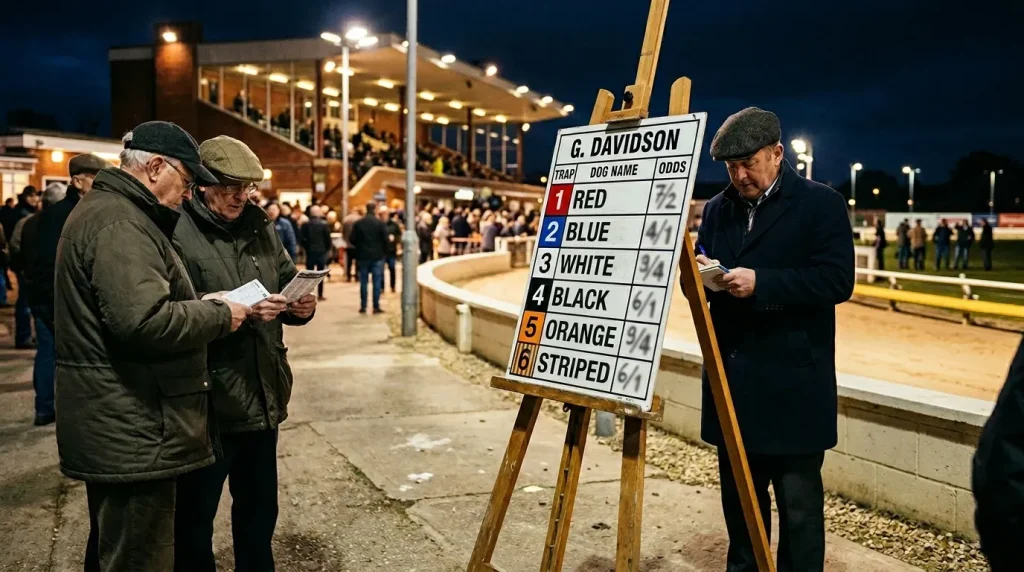
On evening cards — Monday, Friday and Saturday — Oxford has on-course bookmakers who set and adjust their prices in response to money coming in from the track and from off-course betting shops. The SP is determined by an independent assessor who surveys the on-course boards at the moment the traps open. This process is relatively transparent: the price reflects a genuine market, albeit one with limited liquidity compared to horse racing. A dog showing 3/1 on the boards at the off has been priced by bookmakers who are risking their own money, which creates a natural incentive for the price to be broadly accurate.
BAGS cards — the Tuesday and Thursday morning meetings — operate differently. These meetings are broadcast by SIS into betting shops and online platforms, but there are typically no on-course bookmakers. Instead, the SP is derived from the board prices offered by the major bookmaking firms. The Gambling Commission data for the year ending March 2026 shows that betting shop turnover on greyhound racing reached £794 million, a figure that reflects the scale of the BAGS market. But at the individual race level, the money flowing through a Tuesday morning Oxford card is thin. This means BAGS SPs can be less efficient — prices are set with less information, adjusted with less precision and occasionally drift to levels that do not reflect the true probability of the outcome.
The morning line — the initial set of prices published before the meeting — is the starting point for both types of card. It is compiled by a tissue pricer who assesses the form and assigns preliminary odds. From there, the prices move in response to betting activity: money on a dog shortens its price, lack of money lets it drift. On an evening card with active on-course bookmakers, this movement is visible and responsive. On a BAGS card, the movement is slower and can leave pockets of value for punters who have done their form work properly.
SIS plays a central role in the distribution of Oxford odds. Their cameras and data feeds transmit the prices from the track to every platform that carries BAGS racing, which means the odds you see on Bet365 or William Hill for an Oxford morning card originate from the same SIS-transmitted board. There is no separate exchange market for most BAGS races, which limits the alternative pricing sources available to punters and makes the bookmaker SP the default settlement mechanism.
Bookmaker SP vs Betfair BSP — Which Gives Better Value?
Betfair’s Starting Price (BSP) is an alternative to the traditional bookmaker SP, and for Oxford greyhound racing it offers a genuinely different product. BSP is calculated after the race, using the final state of the Betfair exchange market at the point the traps open. It includes no bookmaker margin — instead, Betfair takes a commission on winning bets. This structural difference means BSP is often, though not always, a better price than SP.
The logic is straightforward. A bookmaker builds a margin into every market — typically between 15% and 25% overround on a six-dog greyhound race. That margin means the sum of all implied probabilities in a bookmaker market exceeds 100%, and the punter is systematically paying for the difference. BSP has no built-in overround. The price reflects the combined opinion of everyone who traded on the exchange, minus Betfair’s commission, which for most users sits between 2% and 5% depending on their account status.
In practice, BSP tends to be better than SP on favourites and roughly equivalent on outsiders. A dog priced at 2/1 SP might return 2.2 or 2.3 on BSP, because the exchange market is more efficient at pricing short-priced runners. At longer odds — 8/1 and above — the BSP advantage narrows and can occasionally reverse, because the exchange market is thinner and a single large bet can distort the final price.
The UK greyhound betting market generated $1.81 billion in turnover in 2026, according to industry data compiled by GREY2K, representing approximately a quarter of the global greyhound betting market. But only a fraction of that passes through exchanges. The majority flows through bookmaker channels — high street shops, online sportsbooks and the SIS-powered BAGS system. This imbalance means exchange liquidity on individual Oxford races, particularly BAGS cards, can be low. If you plan to take BSP, check that there is enough matched money in the market to give you a representative price. On a Friday evening card, liquidity is usually adequate. On a Tuesday morning BAGS race, it may not be.
Identifying Value in Oxford Greyhound Markets
Value in betting is the gap between what the odds say and what the probability actually is. If a dog is priced at 4/1, the market implies a 20% chance of winning. If your own assessment puts the true probability at 30%, you have found value — the price is paying you more than the risk warrants. The challenge at Oxford, as at any track, is building an assessment that is more accurate than the market’s.
Oxford’s trap bias is the most accessible edge. Trap 5 wins 23.5% of graded races, which translates to a fair price of roughly 3.25 (or slightly better than 9/4). If a dog drawn in trap 5 is available at 4/1 or longer, the trap bias alone suggests the market is underestimating its chances — assuming the dog is a competent racer with reasonable form. This does not mean every trap 5 runner is a value bet, but it does mean the starting point for evaluation is more favourable than for a dog drawn in trap 6, where the win rate drops to 16% and the fair price stretches beyond 5/1.
Going conditions create another layer of inefficiency. When the track is running slow after rain, some dogs handle the heavier surface better than others. The market adjusts partially for this — a known mud-lark might shorten on a wet day — but it rarely adjusts fully, because most punters do not track going-adjusted times for individual dogs at Oxford. If you have kept records of how specific dogs perform on different going reports, you can identify runners whose raw form understates their ability under today’s conditions.
New arrivals are a consistent source of mispricing. A dog making its Oxford debut after transferring from another track has no Oxford-specific form for the market to evaluate. It might have trialled well, it might suit the surface and the distance, but the absence of Oxford data leaves the market guessing. If you have followed the trial results and know the dog posted a quick time, you hold information that most of the betting public does not — and that asymmetry is where value lives.
The discipline is straightforward but difficult to sustain: assess the probability, compare it to the price, bet only when the gap is in your favour. At Oxford, the data is available to make those assessments with reasonable confidence. The trap statistics, the going records, the trainer form — all of it is there for anyone willing to look. The value belongs to the punters who actually do.