Greyhound Racing Betting Types — Win, Place, Each-Way and Exotic Bets
 Available in US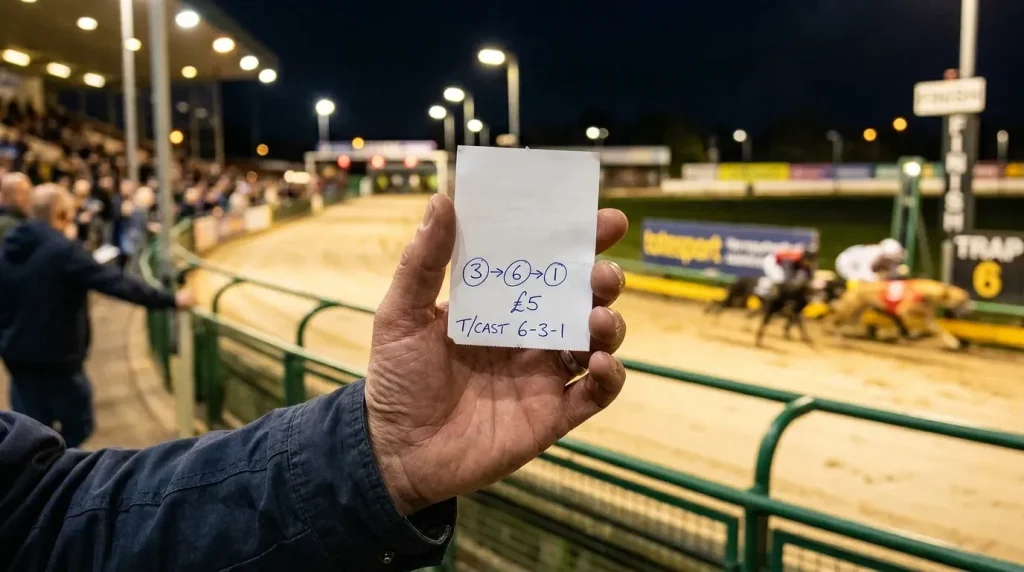
Greyhound racing offers a wider range of betting types than most people realise. The six-dog field — standard at every GBGB-licensed track including Oxford — creates a concentrated menu of outcomes that lends itself to everything from a straightforward win bet to a complex combination tricast. Each bet type serves a different purpose, carries a different risk profile and suits a different type of punter.
Understanding the full catalogue of greyhound betting types is not just academic. The bet you choose determines your return profile: a win bet pays modestly but often; a tricast pays spectacularly but rarely. Matching the right bet type to the right race — based on the distance, the field quality and your level of confidence — is a skill that separates disciplined punters from those who default to the same wager every time regardless of circumstances.
Win, Place and Each-Way — The Foundation Bets
The win bet is the simplest wager in greyhound racing: pick the dog that finishes first. If it wins, you collect the dividend at the starting price (or the fixed price you took earlier). If it finishes second or worse, you lose your stake. The appeal is clarity — one outcome, one result, no ambiguity.
In a six-dog race, the theoretical probability of any randomly selected dog winning is 16.67%. In practice, the field is not random — some dogs are faster, better drawn and better trained than others — but the baseline gives you a sense of what the odds should look like. A dog priced at evens (1/1) is being given approximately a 50% chance by the market, which is three times the random probability. For that price to represent value, the dog needs to be genuinely dominant.
The place bet asks you to pick a dog that finishes in the top two. In six-runner greyhound races, the standard place terms are first or second. This halves the difficulty compared to a win bet — your selection has two qualifying positions instead of one — but the reduced risk is reflected in a reduced payout. Place odds are typically a fraction (usually one-quarter to one-third) of the win odds, depending on the bookmaker and the market.
The each-way bet combines a win bet and a place bet into a single wager at double the unit stake. If your dog wins, both the win and the place parts pay out. If it finishes second, only the place part pays, and you lose the win stake. If it finishes third or worse, you lose both stakes. Each-way betting is popular among punters who like a longer-priced selection but want insurance against a near-miss — the dog that runs a great race but just fails to win.
The UK greyhound betting market through betting shops alone turned over £794 million in the year to March 2026. Win, place and each-way bets account for a significant portion of that volume, particularly among casual bettors and those who follow BAGS racing through the shop screens. These are the gateway bets — the ones that most people start with before exploring the more complex options.
Forecast, Tricast, Accumulator and Tote Pools
Beyond the basic bets, greyhound racing offers a suite of exotic wagers that increase both the difficulty and the potential reward. The forecast requires you to predict the first and second finishers; the tricast extends that to first, second and third. Both can be placed as straight bets (exact order) or combination bets (any order), with the combination multiplying your stake by the number of permutations covered.
Forecasts and tricasts are the most popular exotic bets at Oxford, and the dividends can range from modest (two short-priced dogs filling the forecast in a predictable race) to substantial (three outsiders completing an unlikely tricast in a competitive 450-metre event). The Computer Straight Forecast (CSF) and Computer Tricast (CT) formulas calculate the dividend after the race based on the SPs of the placed dogs, removing the need for bookmakers to price every possible combination in advance.
The accumulator is a bet that links two or more selections across different races. All selections must win for the bet to pay out, but the odds multiply together, which means a successful four-race accumulator can return many times the stake. Accumulators are popular on BAGS cards, where a punter might link four or five Oxford selections from a single meeting. The appeal is obvious — a £1 stake can return £50 or more — but the probability of success drops sharply with each additional leg.
Doubles and trebles are specific types of accumulator: a double links two selections, a treble links three. These are often used as standalone bets, and some punters build a system of doubles and trebles across a card as an alternative to placing multiple single bets. The mathematics of combining odds means that even modest individual selections can produce attractive combined returns.
Tote pools operate on a pari-mutuel basis, where all bets of a given type are pooled together and the dividend is calculated by dividing the pool among the winning tickets after a deduction for the operator. Tote pools on greyhound racing are smaller than on horse racing, which means the dividends can be volatile — a large bet into a small pool can dramatically alter the payout. The Tote Jackpot and similar pooled bets offer the largest potential returns but require multiple correct selections across a series of races.
Choosing the Right Bet — Matching Bet Type to the Oxford Card
The best bet type depends on the race, not on personal preference. At Oxford, the three distances produce different competitive dynamics, and matching your bet type to those dynamics improves your expected return.
Over 253 metres, the sprint favours win bets. The short distance means the outcome is heavily influenced by the trap draw and the break speed, which reduces the number of realistic contenders in most fields. If you can identify the fastest breaker in the best trap, a win bet captures the value without the additional complexity of predicting second and third places. The dividends on sprint forecasts tend to be modest anyway, because the finishing order is often predictable.
Over 450 metres, forecasts come into their own. The two-bend trip introduces enough uncertainty — positional changes on the second bend, closers catching leaders, traffic incidents — that predicting the exact first two is genuinely challenging and correspondingly well rewarded. This is the distance where the CSF dividends are most volatile, and where a well-judged reverse forecast can return a meaningful profit from a modest stake.
Over 650 metres, each-way betting suits the dynamic. The staying trip tests stamina and tactical pacing, and upsets are more common because the extended distance amplifies small differences in class and fitness. Backing a longer-priced stayer each-way gives you a safety net — if it runs into second behind a superior rival, the place return covers your stake and may still produce a profit.
Oxford Stadium managing director Kevin Boothby has spoken about wanting the venue to be a flagship that attracts friends, families and work colleagues. The betting menu is part of that appeal — it offers something for every level of engagement, from the casual visitor placing a £2 win bet on the next race to the serious student building a structured portfolio of forecasts and tricasts across the evening card.
The wider context is set out in our Oxford dogs results guide.
