
SIS Racing and Greyhound Broadcasting — How UK Races Reach Betting Shops
 Available in US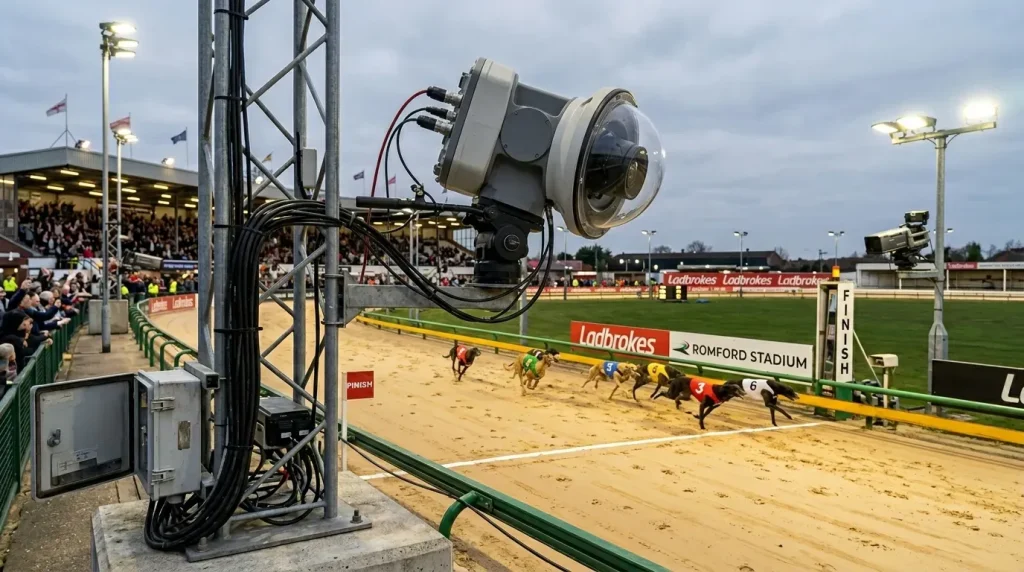
SIS racing — formally Sports Information Services — is the company that makes greyhound betting possible in the UK. Without SIS, there would be no live footage in betting shops, no streaming on bookmaker apps, no real-time odds transmitted from track to screen. Every Oxford greyhound race that appears on your phone, your laptop or the wall-mounted monitor in your local bookmaker travelled through the SIS network to get there.
SIS is not a bookmaker, not a track operator and not a regulator. It is a media and data company that sits between the tracks and the betting industry, producing, distributing and monetising the racing content that both sides depend on. Understanding how SIS works — and how Oxford fits into its broadcasting schedule — explains the mechanics behind a sport that most punters experience exclusively through a screen.
How SIS Works — Cameras, Satellites and Betting Shop Screens
The SIS operation begins at the track. At every GBGB-licensed stadium that holds BAGS meetings — including Oxford — SIS installs and maintains the camera equipment, commentary facilities and data transmission infrastructure needed to produce a broadcast-quality racing feed. Multiple cameras cover the traps, the bends, the finish line and the parade ring. A commentator calls the race live. The data feed — runner information, trap draws, odds, finishing times — is overlaid onto the video signal.
From the track, the combined video and data signal is transmitted to SIS’s distribution network, which delivers it simultaneously to betting shops, online platforms and international simulcast partners. The transmission is near-instantaneous — the delay between the race happening on the track and the image appearing on a betting shop screen is measured in seconds, not minutes. This speed is essential because live betting markets remain open until the traps open, and any significant delay would create arbitrage opportunities between viewers at the track and viewers on the screen.
The scale of the operation is considerable. SIS broadcasts 53 greyhound meetings per week from UK and Irish tracks, producing up to 33,000 individual races per year. A new race goes off approximately every seven minutes across the network, which means there is almost always a live greyhound race available for betting at any point during the broadcasting day. Oxford contributes five meeting days per week to this schedule — a significant share of the total output.
Revenue flows in both directions. SIS pays media rights fees to the tracks for the content it broadcasts, and it charges bookmakers for access to the feed. The tracks receive a guaranteed income from these rights payments, which for most BAGS venues constitutes the single largest revenue stream. Bookmakers receive a product that drives betting turnover in their shops and on their platforms. SIS takes a margin in the middle. The arrangement has been stable for decades, though the declining betting turnover on greyhounds has put pressure on all three parties.
The quality of the SIS broadcast has improved substantially over the years. What began as grainy closed-circuit television footage in the 1960s is now a high-definition digital production with professional commentary, real-time graphics and multi-camera coverage. The viewing experience on a modern bookmaker app is comparable to any live sports broadcast, which has helped sustain interest in greyhound racing among bettors who might otherwise dismiss the product as outdated.
Oxford on SIS — Five Days a Week of Coverage
Oxford’s racing schedule gives it one of the heaviest SIS footprints among BAGS tracks. The stadium holds meetings on Monday, Tuesday, Thursday, Friday and Saturday, with the Tuesday and Thursday cards operating as dedicated BAGS broadcasts. These morning meetings are produced entirely for the SIS feed — there are no on-course bookmakers and minimal live attendance — and they represent the purest expression of the BAGS model: racing as content for the betting industry.
The Monday, Friday and Saturday cards are evening meetings with live attendance, on-course bookmakers and a social-event atmosphere. SIS still films and broadcasts these meetings, but they serve a dual purpose — entertainment for the on-course audience and content for the off-course betting market. The evening meetings tend to feature stronger fields, including open races that attract dogs from outside the regular Oxford grading pool, and the SIS coverage reflects this with more detailed pre-race analysis and commentary.
Oxford’s five-day schedule means the stadium generates a substantial volume of data for the SIS network. Each meeting typically includes 10 to 14 races, which translates to 50 to 70 races per week — all filmed, commentated, data-tagged and distributed. For punters who specialise in Oxford, this volume is an advantage: it provides a deep form database, frequent updates and enough racing to identify and exploit statistical patterns that shallower schedules would not reveal. The consistency of the SIS production means you can study Oxford races from any platform and receive the same data quality — the same camera angles, the same commentary standard, the same timing precision — regardless of whether you watched live or reviewed the replay hours later.
Global Reach — SIS Feeds for US, Australian and European Bettors
SIS does not limit its distribution to the UK. The company operates an international feed that carries UK and Irish greyhound racing to betting markets around the world, making Oxford races available to punters who have never set foot in Oxfordshire and may never do so.
The United States is the primary international market. UK greyhound racing is distributed to US-based advance deposit wagering platforms and simulcast facilities through SIS’s international arm. The racing is timed to fill gaps in the American wagering calendar — Oxford’s morning BAGS cards air during the US overnight hours, while the evening meetings align with the American afternoon. The seven-minute interval between races across the SIS network is specifically designed to suit the rhythm of simulcast wagering, where bettors at a single facility follow races from multiple venues in quick succession.
Australian bettors also have access to SIS greyhound content, though the regulatory framework and platform availability differ from the US model. In Australia, UK greyhound racing competes for attention with a robust domestic greyhound industry, but the time-zone offset means UK races fill a slot in the Australian schedule that local content does not cover. European markets, including those in regulated betting jurisdictions like Malta and Gibraltar, also receive SIS feeds through licensed bookmaker platforms.
The international dimension adds a layer to Oxford’s economic significance. Every bet placed on an Oxford race by a US simulcast customer or an Australian online punter generates turnover that feeds into the levy system and, ultimately, back to the sport. The SIS international feed turns a Tuesday morning BAGS card at Oxford into a global product — modest in scale, perhaps, but connected to a worldwide network that extends the stadium’s commercial reach far beyond Sandy Lane. For an industry seeking to offset declining domestic turnover, the international market is not a luxury — it is a necessary revenue stream that helps sustain the tracks and the racing programme that UK punters depend on.
The wider context is set out in our Oxford dogs results guide.
