
Oxford Greyhound Racing Schedule — Race Days, Times and BAGS Fixtures
 Available in US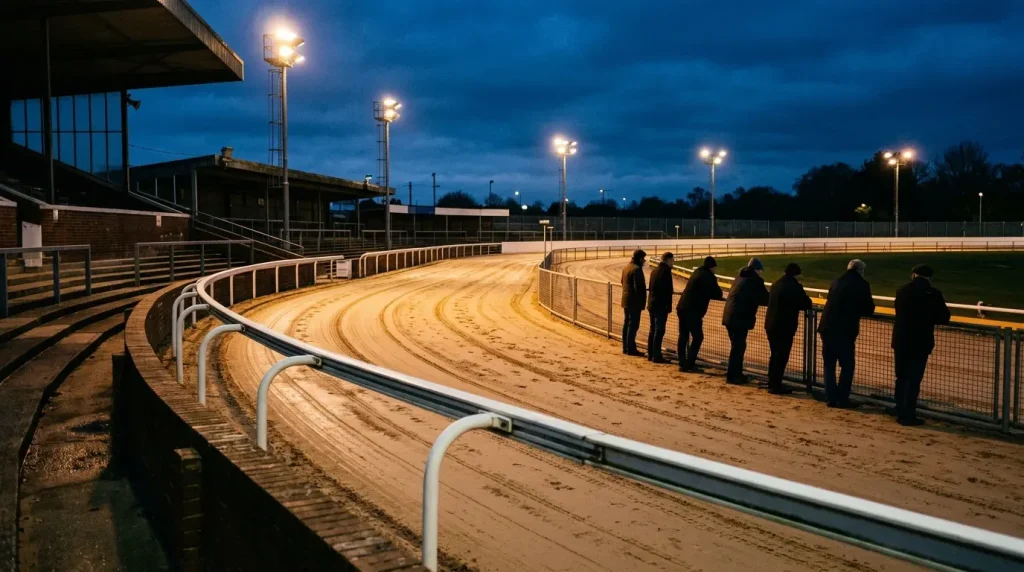
Oxford Stadium holds greyhound racing five days a week — Monday, Tuesday, Thursday, Friday and Saturday — making it one of the busiest licensed venues in the GBGB network. That volume is not accidental. The Oxford racing schedule is split between three daytime BAGS meetings, designed to feed content into betting shops and online platforms, and two evening sessions that draw live crowds, host open-race events, and carry the atmosphere of a proper night out. Understanding which type of meeting falls on which day, and what the differences mean for the racing itself, is the first step toward using the schedule to your advantage.
Since Oxford Stadium reopened in September 2022 after a ten-year closure, the fixture list has settled into a rhythm that reflects both the commercial reality of modern greyhound racing and the stadium’s dual identity as a greyhound and speedway venue. Greyhounds and speedway share the same Sandy Lane site but operate on different surfaces and different days, and the interaction between those two calendars shapes how and when you can visit. Add in the seasonal calendar of open-race nights — including the now Category One Sandy Lane Sprint — and Oxford’s schedule becomes more layered than a casual glance at the fixture list might suggest.
This guide unpacks the full Oxford racing schedule for 2026: the weekly timetable with exact start times, how BAGS racing works and why it dominates the weekday card, the distinction between evening and morning meetings, the speedway overlap, and the special events that punctuate the season. Whether you are planning a Friday night out or looking for a Tuesday afternoon BAGS card to bet from your sofa, the schedule below tells you what to expect and when to expect it.
Oxford Weekly Race Schedule — Day-by-Day Breakdown
The standard Oxford greyhound week runs across five days with fixed meeting types and start times. Each meeting typically features twelve races, though open-race nights may carry a slightly different card structure. Here is the day-by-day picture.
Monday — BAGS afternoon, first race 14:26. Monday is a pure BAGS card. The twelve races are graded, meaning dogs are grouped by ability under the GBGB classification system. The atmosphere is functional rather than festive — this is a meeting designed for betting content rather than live attendance, and most of the action is consumed via SIS feeds in betting shops or streamed through bookmaker apps. The grading tends to sit in the A4 to A7 range, competitive enough to produce close finishes but without the headline dogs you see on open-race nights.
Tuesday — BAGS afternoon, first race 14:26. Tuesday mirrors Monday in format and purpose. Another twelve-race graded card, same start time, same BAGS broadcasting infrastructure. The consistency is deliberate — bookmakers rely on a predictable supply of racing content throughout the week, and Oxford’s Tuesday card fills a slot in the national BAGS schedule alongside meetings at other tracks. For bettors, Tuesday offers the same analytical opportunities as Monday: form, trap draw, and going conditions all apply in exactly the same way.
Thursday — BAGS morning, first race 10:32. Thursday is the early start. The first race goes off at 10:32, making this the earliest meeting of the Oxford week. The format is the same twelve-race graded card, but the earlier start time changes the practical dynamics. Going conditions may differ from afternoon cards because the track has had less time to dry or warm up, and the field quality can vary slightly as trainers manage which dogs run on the morning versus afternoon schedule. For the bettor who works weekday afternoons, Thursday morning is the only Oxford card that fits a conventional schedule.
Friday — evening meeting, first race 17:47. Friday marks the shift from daytime content to live entertainment. The first race moves to 17:47, and the card is structured as an evening event with a mix of graded and potentially higher-grade races. Friday nights draw a significantly larger live crowd than the daytime BAGS meetings, and the atmosphere at Oxford Stadium reflects it — the SAVANA Bar and Restaurant operates fully, hospitality packages are available, and the noise level rises. From a betting perspective, Friday evening fields often include dogs that trainers have deliberately held back from midweek cards to run fresh at the weekend.
Saturday — evening meeting, first race 17:47. Saturday is Oxford’s flagship night. Same 17:47 start time as Friday, same evening format, but Saturday typically hosts the best racing of the week. Open-race events, when they fall on the calendar, are usually scheduled for Saturday evenings. The fields may include higher-graded dogs, and the prize money for open events lifts the quality of the card above the typical BAGS offering. For first-time visitors, Saturday evening is the recommended entry point: the racing is strong, the hospitality is running at full capacity, and the overall experience is closer to an event than a transaction.
Wednesday and Sunday are not greyhound days at Oxford — those slots belong to speedway and are off-limits for dog racing. This five-day, twelve-race structure gives Oxford roughly sixty races per week, or over three thousand per year, which places it among the most productive tracks in the GBGB system.
What Is BAGS Racing and Why Does Oxford Run Morning Cards?
BAGS stands for the Bookmakers Afternoon Greyhound Service, a system that has been the commercial backbone of British greyhound racing since the late 1960s. The concept is simple: licensed tracks stage races during the day, those races are broadcast into betting shops via satellite, and bookmakers offer odds to their customers. The tracks receive media rights payments, the bookmakers get content to fill their screens, and the betting public gets something to wager on between the morning coffee and the evening football. It is a symbiotic arrangement that funds the majority of greyhound racing in Britain.
Oxford holds a particular place in BAGS history. When the service launched in 1967, Oxford was one of only four tracks selected for the initial contract — alongside Hackney, Kings Heath and Park Royal. That founding status reflected Oxford’s position as a well-run, centrally located venue with the infrastructure to support regular broadcasts. Nearly sixty years later, BAGS racing remains the engine that drives Oxford’s weekday schedule, and the three daytime meetings on Monday, Tuesday and Thursday exist primarily to serve that system.
The broadcasting infrastructure behind BAGS is managed by SIS — Sports Information Services — which operates the cameras, satellite links and data feeds that connect tracks to bookmakers. According to data cited by GREY2K USA, SIS broadcasts approximately 53 greyhound meetings per week from tracks across the UK and Ireland, generating up to 33,000 individual races per year. Oxford’s three BAGS meetings contribute roughly thirty-six races per week to that total — a meaningful share of the national content supply.
The reason Oxford runs morning and afternoon cards rather than staging all its racing in the evening is purely commercial. Betting shops are open during the day, and daytime greyhound racing fills a gap in the content schedule when horse racing may be limited and football is not yet underway. The morning start on Thursday (10:32) is designed to capture early shop traffic, while the Monday and Tuesday afternoon slots (14:26) align with the traditional post-lunch betting window. These time slots are agreed between the tracks, SIS and the bookmakers as part of the national BAGS fixture schedule, and Oxford’s position within that schedule has been stable since the stadium’s reopening.
For the bettor watching from home or placing bets through an app, the practical effect of BAGS racing is a steady supply of Oxford form data. Three meetings per week, twelve races per meeting, means that Oxford dogs race frequently enough to generate reliable form figures and trap statistics. The downside is that BAGS cards tend to attract thinner betting markets than evening meetings, which means the odds can be less efficient — and less efficiently priced markets are where informed bettors find the most opportunity.
Evening Meetings vs Morning Cards — What’s Different?
The split between Oxford’s daytime BAGS meetings and its Friday/Saturday evening sessions is not just a matter of clock time. The two types of meeting differ in grading, atmosphere, betting dynamics and the quality of data available to punters. Treating them as interchangeable is a mistake that costs money.
Grading is the most significant difference. BAGS cards on Monday, Tuesday and Thursday are populated by dogs in the middle grades — typically A4 through A7, with occasional A3 or A8 runners filling out the card. The fields are closely matched because the grading system does its job: dogs of similar ability race against each other, which makes the results harder to predict and the trap draw more influential. Evening meetings, by contrast, can include higher-graded dogs and, on open-race nights, animals from the A1 and A2 tiers who are contesting named events. The class gap between the best and worst dog in an evening field is sometimes wider than on a BAGS card, which shifts the balance of predictive factors from trap geometry toward raw ability.
Live attendance transforms the atmosphere. BAGS meetings are functional events — a small number of spectators may be present, but the primary audience is off-site, watching via SIS feeds. Friday and Saturday evenings bring crowds to Sandy Lane: groups celebrating birthdays, corporate outings booked through the hospitality packages, and regular punters who prefer the buzz of trackside betting to the solitude of a mobile app. The noise, the on-course bookmakers, the restaurant service and the general sense of occasion all contribute to an experience that the morning cards cannot replicate.
Betting markets are deeper on evening cards. More money flows through the markets on Friday and Saturday because the larger audience creates more liquidity. Starting prices on evening meetings tend to be more accurate reflections of true probability, because the weight of money from both on-course and off-course bettors has had more time and more volume to settle. BAGS morning prices, by comparison, are set in thinner markets where a single large bet can move the odds. For the value-oriented punter, this is a double-edged observation: thinner markets offer more opportunities for mispricing, but they also carry more risk that the price you take at 10:30 on a Thursday morning evaporates before the traps open.
Data availability also varies. Evening meetings typically produce more detailed post-race commentary and are more likely to be covered by independent analysts on platforms like Timeform or Racing Post. BAGS cards get the basic data — trap, form, time, SP — but the depth of analysis surrounding each race is shallower. If you are the kind of bettor who builds selections from sectional times and expert race comments, the evening cards give you more to work with. If you rely primarily on your own form database and trap statistics, the BAGS meetings offer a more level playing field where your preparation can outstrip the market’s.
Sharing the Stadium — Greyhounds and Speedway at Oxford
Oxford Stadium is not exclusively a greyhound venue. It is also the home of Oxford Cheetahs speedway, and the two sports share the Sandy Lane site under a carefully coordinated timetable. Speedway occupies Wednesday, Thursday evenings and Sunday, while greyhound racing fills Monday, Tuesday, Thursday mornings, Friday and Saturday. The dual-use arrangement is central to the stadium’s financial model — two revenue streams from one venue — but it introduces practical considerations that affect the racing surface, the visitor experience and the overall schedule.
The speedway track is a separate circuit from the greyhound running surface. Speedway bikes race on a shale or dirt oval, while the greyhounds run on the sand track that encircles it. The two surfaces are maintained independently, and the speedway activity on Wednesday and Sunday does not directly churn up the greyhound track. That said, the general traffic around the stadium on speedway days — vehicles, equipment, foot traffic — means the broader site is busier, and any maintenance work on the greyhound surface between meetings must be scheduled around the speedway calendar.
The reopening of Oxford Stadium in 2022 brought both sports back simultaneously, though on slightly different timelines. Speedway returned on 13 April 2022, with greyhound racing following on 2 September 2022. The staggered launch reflected the different preparation requirements: the speedway surface needed less restoration than the greyhound track, which required significant investment in the sand, the traps and the hare system before GBGB licensing could be secured. Kevin Boothby, the managing director who drove the revival, invested approximately £1.8 million across both the Oxford and Suffolk Downs venues, and the dual-sport model was always part of the business plan.
For visitors, the main practical implication is that not every day at Oxford Stadium is a greyhound day. If you arrive on a Wednesday or Sunday expecting to see dogs, you will find speedway instead. The stadium website and GBGB fixture list both publish the full schedule, but the dual-sport setup catches out first-time visitors more often than you might expect. It is also worth noting that Thursday is the crossover day: greyhounds race in the morning (10:32 start), and speedway may take the evening slot, which means the stadium hosts two different sports on the same day with a turnover of surfaces and crowds in between.
Seasonal Calendar — Open Race Nights and Special Events
The weekly schedule is the skeleton of Oxford’s racing year, but the seasonal calendar adds the muscle. Open-race nights — events that sit above the standard graded cards and attract dogs from across the country — punctuate the schedule at intervals throughout the year, transforming ordinary Friday or Saturday evenings into something closer to festival racing.
The headline event for 2026 is the Sandy Lane Sprint, which has been elevated to Category One status by GBGB. The sprint is run over 253 metres — Oxford’s shortest distance — and the Category One classification places it among the most prestigious sprint competitions in British greyhound racing. According to GBGB’s announcement of the 2026 racing schedule, the Sandy Lane Sprint is one of just four Category One sprint events in the calendar, a significant increase from previous years. The event typically runs in March and follows a heats-to-final format, with qualifying rounds staged across one or two evenings before the final decides the winner.
Beyond the Sandy Lane Sprint, Oxford hosts several other named open events across the year. The bet365 Hunt Cup is the staying showpiece, run over 650 metres and testing stamina and tactical pace over the longer trip. The bet365 Challenge Cup offers another 650-metre test at a different point in the calendar. The Pall Mall Stakes, which was transferred to Oxford from the closed Harringay Stadium in 1988, carries historical weight and remains a fixture on the schedule. The Oxford Puppy Collar provides a platform for younger dogs to compete in a formal open-race setting, and its results often signal which greyhounds will progress to higher-grade competition later in the year.
Louise Warr, Racing Operation Executive at GBGB, captured the significance of the 2026 calendar when she noted: “2026 will be an exciting year for the sport of greyhound racing with a whole host of events taking place to celebrate 100 years both on and off the track.” That centenary context — greyhound racing in Britain marks its hundredth year in 2026 — adds extra meaning to every open-race night this season. Oxford, as a track that closed and reopened within the sport’s modern era, embodies the resilience that the centenary celebrations are designed to highlight.
Seasonally, the open-race calendar tends to cluster in two main windows. The spring period (March through May) typically delivers the Sandy Lane Sprint and early-season puppy events. The autumn and winter stretch (September through December) brings the Hunt Cup and Challenge Cup, along with trial events for dogs entering the next grading cycle. Summer months, when daylight extends into the evening and live attendance peaks, are dominated by higher-quality graded cards rather than formal open events — the English Greyhound Derby, which takes centre stage at its host venue during June and July, draws attention away from individual track calendars.
For the bettor, open-race nights require a different approach than standard graded cards. The fields are stronger, the form guide extends beyond Oxford’s track-specific data, and the trap bias — while still present — is less deterministic when elite-level dogs are involved. Keeping an eye on the GBGB fixture calendar is the simplest way to know when these events land on the Oxford schedule.
Planning Your Visit — Hospitality, Tickets and Getting There
Oxford Stadium sits on Sandy Lane in the Cowley area of Oxford, roughly three miles southeast of the city centre. Access by car is straightforward — the venue has on-site parking, and the approach from the A4142 ring road takes a few minutes. By public transport, the nearest bus routes connect Cowley to central Oxford, though the walk from the closest stop to the stadium adds ten minutes. There is no direct rail link, so visitors arriving by train to Oxford station should plan for a taxi or bus connection.
Admission to standard evening meetings (Friday and Saturday) is available at the gate, and tickets can also be purchased in advance through the Oxford Stadium website. BAGS meetings on Monday, Tuesday and Thursday are technically open to the public, but live attendance is minimal — these are broadcasting events rather than spectator occasions, and the hospitality facilities may not be fully operational during daytime cards.
The centrepiece of Oxford’s hospitality offering is the SAVANA Bar and Restaurant, a trackside dining venue with 180 seats that overlooks the home straight. The restaurant was part of the £1.8 million refurbishment programme that brought the stadium back to life in 2022 — an investment by managing director Kevin Boothby that extended across both the racing infrastructure and the visitor facilities. The SAVANA operates primarily on Friday and Saturday evenings, offering a meal-and-racing package that combines a three-course dinner with a view of the action. Booking in advance is recommended, particularly for Saturday nights and open-race events, when demand regularly fills the room.
For groups and corporate bookings, Oxford Stadium offers several tiered packages. The Fab 5 package is the entry-level hospitality option: it includes admission, a meal and five complimentary bets, bundled into a single price that makes it easy to organise a group night without everyone managing their own tickets and food separately. The Executive Suites provide a more private experience — a dedicated box with trackside viewing, suited to corporate outings or celebrations. Larger groups can arrange bespoke packages through the stadium’s events team, and the venue markets itself actively for birthdays, stag and hen nights, and team-building events.
A few practical tips for first-time visitors. The evening meetings start at 17:47, but arriving thirty minutes early gives you time to settle, study the card, and place your first bets before the action begins. Dress code is relaxed — there is no jacket-and-tie requirement, though the SAVANA restaurant appreciates smart-casual attire. On-course bookmakers operate alongside the tote at evening meetings, so you can shop for the best price rather than accepting a single starting price. And if you are driving, the car park fills up on busy Saturday nights, so building in a buffer against the clock is worth the effort.
The full picture is in our Oxford dogs results guide.
Today’s outcomes appear in results today.
