
Oxford Greyhound Racecard — How to Read Form and Pick Winners
 Available in US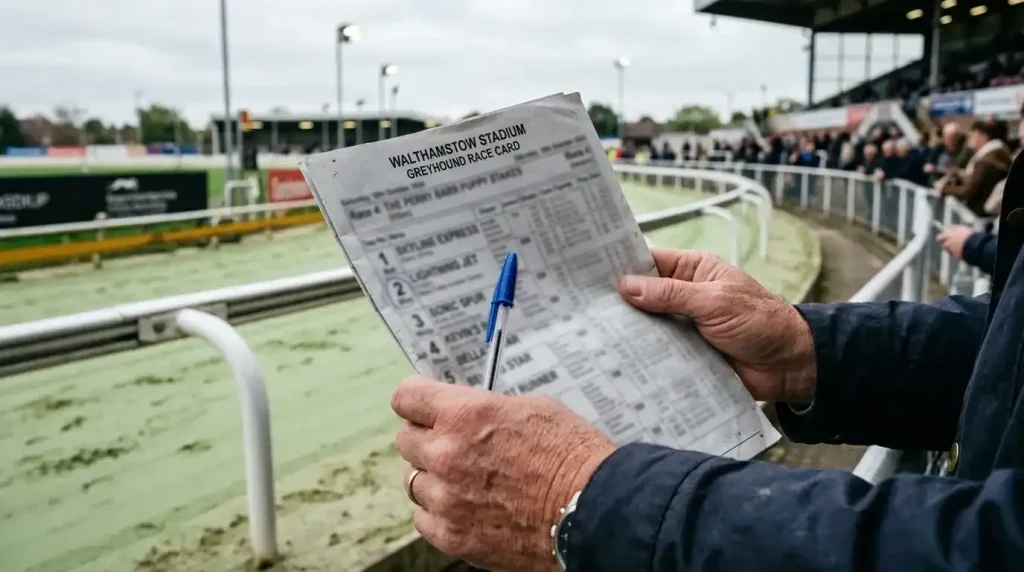
The Oxford greyhound racecard is the single most important document you will read before placing a bet at Sandy Lane. It compresses everything that matters — trap draw, recent form, best times, trainer identity, early pace rating — into a few dense columns of data. If you cannot decode those columns, you are guessing. And guessing at a track with a circumference of roughly 397 metres, three distinct distances, and one of the most asymmetric trap biases in British racing is a reliable way to empty your wallet.
Oxford Stadium returned to licensed greyhound racing in September 2022 after a decade-long closure, and the track has quickly become one of the busiest BAGS venues in the country. Five race days a week, twelve races per meeting, three distances ranging from the explosive 253-metre sprint to the tactical 650-metre staying trip — that is a lot of data to process if you do not know where to look. The racecard organises it for you, but only if you understand what each field actually means.
This guide walks through every element of an Oxford greyhound racecard, from the raw numbers printed by GBGB to the subtleties that separate an informed punter from a pin-sticker. We will cover form figures, trap draw geometry, going reports specific to Oxford’s sand surface, and sectional times that reveal whether a dog leads from the boxes or finishes from behind. By the end, you should be able to pick up any Oxford card, read it in under two minutes, and form a view that is at least better than the morning line.
Breaking Down an Oxford Racecard — Every Column Explained
An Oxford racecard, whether you pull it from the GBGB website, a bookmaker app, or a printed sheet at the track, follows a standard layout. The columns run left to right, and each one answers a specific question about the dog entered in that race. Ignore any of them and you are throwing away free information.
Trap number and colour. The first column tells you which trap the dog breaks from — one through six, each assigned a traditional colour (red, blue, white, black, orange, striped). At Oxford, this is not a cosmetic detail. Trap 5 wins 23.5% of graded races according to 2026 data from Greyhound Stats UK, which is nearly seven percentage points above what random chance would predict. The trap number alone can shift the probability of a race outcome more than any other single factor on the card.
Dog name and trainer. The name identifies the greyhound; the trainer tells you who prepares it. Trainer form at Oxford is worth monitoring because certain kennels specialise in sprint dogs while others focus on stayers, and their strike rates vary significantly by distance. A trainer running a 25% win rate on the 450-metre trip is not the same proposition at 253 metres if their record there is half that figure.
Form figures. Usually printed as a sequence of six digits — for example, 342156 — these represent the dog’s finishing positions in its most recent races, read left to right from oldest to newest. Letters may appear too: m for middle running, w for wide, d for disqualified. We will unpack form figures in the next section, but on first glance they tell you whether a dog is improving (numbers trending lower) or fading (trending higher).
Best time. This is the fastest time the dog has recorded over the relevant distance, usually at the same track. At Oxford, best times for the 450-metre standard trip cluster around 26.5 to 27.5 seconds for graded dogs. A best time significantly below the field average suggests raw ability, but it needs context — the going on the day, the grade of race, and whether the run was solo or in traffic all affect what that number is worth.
Early pace rating. Some racecards include an early pace or sectional time indicator, typically expressed as a number or letter grade. This tells you how quickly the dog reaches the first bend. On a tight track like Oxford, where the run to the first bend is approximately 100 metres, early pace is often the decisive variable. A dog rated as a fast breaker from trap 5 at Oxford is, statistically, in one of the strongest positions in British greyhound racing.
Weight. Listed in kilograms, the dog’s racing weight helps you track condition changes. A gain of more than a kilogram between races can signal fitness issues or a change in training, while a slight drop sometimes accompanies sharpened speed. Weight alone rarely decides a result, but sudden swings deserve a second look.
Grade and race type. The racecard header tells you whether the race is graded (A1 through A10, with A1 being the highest) or an open event. Graded races are the bread and butter of BAGS racing — morning and afternoon cards designed for betting shop content, where dogs of similar ability compete. Open races, by contrast, attract higher-class animals and carry bigger prize money. The distinction matters because trap bias behaves differently when the field quality changes: in graded racing, the trap draw exerts more influence because the dogs are closely matched, while in open events, class can override geometry.
Comments. The final column on many racecards includes a brief text note from the racing manager or handicapper — phrases like “led to line,” “crowded bend 1,” or “slow away.” These micro-narratives explain why a dog finished where it did, and they are especially useful at Oxford because the tight bends generate more crowding incidents than you would see at a larger-circumference track like Towcester or Monmore Green.
One practical note: BAGS cards (Monday, Tuesday, Thursday mornings) and evening cards (Friday, Saturday) present the same columns, but the depth of commentary tends to be thinner on morning meetings. If you are betting BAGS at Oxford, you may need to supplement the printed card with data from Greyhound Stats UK or Timeform to fill the gaps.
Reading Form Figures — What the Numbers Tell You at Oxford
Form figures are greyhound racing’s shorthand for performance history, and at Oxford they carry a few quirks that do not apply at every track. The standard format is a string of six characters — typically digits from 1 to 6 — representing the dog’s finishing positions across its most recent outings. The leftmost figure is the oldest run; the rightmost is the most recent. A sequence like 111234 tells you the dog won three races in a row, then started sliding — perhaps promoted to a higher grade and struggling with the step up.
The numbers are straightforward: 1 means first, 6 means last. But between 2 and 5, the meaning is nuanced. A string of 2s and 3s might look mediocre, yet at Oxford it can signal a dog that consistently runs well from an unfavourable trap and could win if the draw improves. Conversely, a dog showing 1s from trap 5 — where the win rate sits at 23.5% — might simply be benefiting from geometry rather than class. When that dog gets reassigned to trap 6, where the win rate drops to 16.0%, the form figures could look very different next time.
Letters interrupt the number sequence to flag specific incidents. The most common at Oxford are m (middle running — the dog raced in the middle of the pack without significant trouble), w (wide — the dog ran wider than ideal, typically losing ground on the bends), and d (disqualified, usually for interference). You may also see F (fell), T (was trapped or severely hampered at the start), and — (the dog did not finish or was withdrawn). On Oxford’s tight 397-metre circuit, w and m appear frequently because there is limited room on the bends. A dog showing repeated w figures at Oxford is losing more ground per lap than it would at a wider track, and its finishing positions may not reflect its true ability.
One of the most useful tricks for reading Oxford form is to separate results by distance. A dog with the form string 162341 might look average at first glance, but if the 1s were both recorded over 253 metres and the 6 was on a 650-metre staying trip, you are looking at a sprint specialist entered at the wrong distance on one occasion. The racecard does not always break form down by trip, so you may need to cross-reference with a database like Greyhound Stats UK. At Oxford, where the three distances demand entirely different skill sets — raw speed for the sprint, a blend of pace and stamina for the standard 450 metres, and tactical endurance for the 650 — distance-specific form is more informative than aggregate figures.
Recent form matters more than lifetime form. A dog that ran 111 three months ago but has posted 456 in its last three starts is a fading proposition, regardless of what it once achieved. Greyhounds peak quickly and decline quickly. At Oxford, where the racing calendar runs five days a week and dogs can race twice in the same week, the recency of form is especially important. A 450-metre time of 26.80 seconds recorded on Friday night carries more predictive weight than a 26.50 personal best set four months earlier.
There is also the question of track form versus away form. A dog transferring from Hove or Romford may have strong figures, but those numbers were generated on a different surface, different circumference, and different trap geometry. Oxford’s sand surface, outside Sumner hare, and relatively tight bends mean that form from wider, faster tracks does not always translate. Look for dogs that have at least two or three runs on the Oxford card before weighting their form heavily — first-time visitors are inherently riskier bets.
Why the Trap Draw Matters More at Oxford
At most greyhound tracks, the trap draw is one factor among several. At Oxford, it is the factor. The stadium’s circumference of approximately 397 metres makes it one of the tighter circuits in the GBGB network, and tight circuits amplify the advantage of certain trap positions because dogs reach the first bend sooner and with less room to manoeuvre. The result is a trap bias that is among the most pronounced at any BAGS track in Britain.
The numbers from Greyhound Stats UK for 2026 graded racing tell the story clearly. Trap 5 has won 23.5% of races — nearly a quarter, from a field of six. Trap 4 follows at 19.9%, then trap 1 at 19.7%, trap 3 at 18.9%, trap 2 at 17.6%, and trap 6 at just 16.0%. In a perfectly balanced system, each trap would win one in six races, or 16.67%. Trap 5 exceeds that baseline by almost seven percentage points, while trap 6 barely reaches it. Those are not marginal differences. Over hundreds of races, they translate into real money for anyone who factors them into their assessments.
The geometry explains why. On the 253-metre sprint, dogs break from the traps and hit the first bend within a few seconds. Trap 5, positioned second from the outside, gets a clean run into the bend without being squeezed by the rail or forced to swing extra-wide like trap 6. The dog on the inside (trap 1) can also fare well if it breaks fast, because it has the shortest distance to travel on the turn. But trap 6, on the extreme outside, must cover more ground on every bend, and that accumulated distance loss across even one turn is often enough to cost a race at sprint distance.
On the 450-metre standard trip, the dynamics shift slightly. Two bends come into play, and the first bend remains critical, but there is more time for a strong-finishing dog to recover from a poor position. Trap 5 still holds an advantage, though it is less overwhelming than on the sprint. Trap 4 benefits from a mid-outside line that avoids the worst of the traffic around traps 1 through 3, where crowding incidents are most common on the first bend.
At 650 metres — the staying trip — the bias begins to flatten out. Three or more bends mean that pace, stamina, and tactical positioning start to outweigh the starting trap. A dog with strong late pace from trap 2 has enough distance to find a gap and close down a front-runner from trap 5. This is why serious staying bettors at Oxford tend to focus more on sectional times and trainer patterns than on the trap draw alone.
There is a practical takeaway for anyone reading the racecard. When you see two dogs with similar form, similar best times, and comparable early pace ratings, the one drawn in trap 5 on a 253-metre race has a structural advantage that the other does not. This does not mean trap 5 always wins — it means that, all else being equal, it wins more often than it should, and ignoring that fact is leaving information on the table.
One more subtlety: the trap draw on the racecard is not always the same as the trap the dog has raced from previously. Dogs get reassigned traps when they move between grades or when the racing manager adjusts the card. A dog showing strong form from trap 5 may look less impressive if tonight it is drawn in trap 6. The racecard tells you both the current draw and the historical trap from prior runs, and the gap between them is worth your attention.
Going Reports and Weather — How Oxford’s Sand Track Reacts
Oxford runs on a sand surface, and sand behaves differently from the polytrack or Nottingham-style fibre surfaces used at some other GBGB venues. On a dry evening, the going is typically described as “normal” or “fast,” and the times reflect it — the current track record for 450 metres is 26.47 seconds, set by Alright Twinkle in February 2026 on a fast-going card. When rain arrives, the sand absorbs moisture and becomes heavier, which slows times and changes the way dogs interact with the bends.
The going report appears on the racecard header, usually as a single word: fast, normal, slow, or sometimes a hybrid like “normal to slow.” This is the racing manager’s assessment of the surface before the first race, and it can change during a meeting if weather conditions shift. For the bettor, the going report is a recalibration tool. A dog whose best time is 26.70 on fast going might run 27.10 or slower on a heavy surface, and that difference can move it from competitive to outclassed.
What makes Oxford’s sand surface distinctive is its drainage pattern. Sand drains better than clay-based tracks, so the going can recover relatively quickly after a shower. But sustained rain — the kind of persistent drizzle that Oxfordshire gets plenty of between October and March — turns the surface genuinely heavy and tends to shift the trap bias. On wet cards, inside traps (1 and 2) sometimes lose their advantage because the rail line holds more water and the sand there compacts differently. Outside traps, which run on a section of the track that sheds moisture faster, can see their win rates tick upwards. This is not a guaranteed phenomenon — it depends on the specific conditions and recent track maintenance — but it is a pattern worth tracking if you bet Oxford regularly through the winter months.
When reading the racecard, look at the going alongside each dog’s previous race comments. A note like “slipped bend 2” in a prior run on slow going tells you the dog may struggle on wet sand. Conversely, a dog whose best performances came on slow going might be worth backing when the rain moves in, especially if the market does not adjust its odds to reflect that preference.
Oxford also shares its stadium with speedway racing, which runs on different days. While the greyhound track is separate, the full stadium calendar is worth knowing because it occasionally affects access and scheduling around maintenance windows.
Sectional Times — Measuring Early Pace at Oxford
Sectional times break a race into segments, and at Oxford the most important segment is the one you cannot see on every racecard: the split from the traps to the first bend. This number — sometimes published by Timeform or available through Greyhound Stats UK — tells you how quickly a dog reaches the first turn, and on a tight track where the first bend often decides the result, it is arguably more valuable than the overall finishing time.
On the 253-metre sprint, early pace is almost everything. The entire race is over in roughly 15 seconds, and the dog that leads into the first bend wins the majority of those contests. The current track record for 253 metres is 14.85 seconds, set by Jazzy George in March 2026 — a time that leaves barely any room for a slow-starting dog to recover. If the sectional to the first bend shows a dog clocking 4.0 seconds while its rivals are at 4.3 or 4.4, that advantage translates directly into clear running and a shorter path on the bend.
At 450 metres, the picture gets more layered. The first-bend sectional still matters — front-runners win more often than closers at Oxford on the standard trip — but there is enough track remaining for a dog with strong late pace to make up lost ground. Here, you want to compare two numbers: the sectional time to bend one and the finishing time. A dog that posts a slow first split but a competitive overall time is finding pace in the second half of the race. That run style can be profitable when the market assumes a dog is outclassed based purely on its early position.
The 650-metre staying trip introduces a third element: the ability to sustain pace through multiple bends. Sectional times on stays are less commonly published in full, but when available, the split between the third and fourth bends reveals which dogs are tiring. A dog whose sectional widens by half a second over the final 200 metres may have led for most of the race but is vulnerable to a closer who maintains consistent speed throughout.
Not every racecard prints sectional data. BAGS morning cards at Oxford, which cater primarily to the betting shop market, often omit sectionals in favour of the basic columns — trap, form, best time, weight. If you are betting those meetings and want the full picture, you will need to build your own sectional database from race replays or use a paid service like Timeform, which calculates estimated sectionals from video analysis. It is an extra step, but on a track where early pace correlates so strongly with the outcome, the effort has a measurable payoff.
One final point on reading sectionals from the racecard: beware of dogs trialled on an empty track. Trial times are recorded without race traffic, which means the first-bend sectional is pure speed with no crowding or checking. A trial sectional of 3.9 seconds to bend one will not necessarily replicate in a six-dog race where the trap 1 dog drifts wide or the trap 3 dog stumbles at the start. Trial data is useful for assessing raw ability, but race-day sectionals are the numbers that matter for betting.
Putting It All Together — A Sample Oxford Racecard Walkthrough
Theory is useful, but racecards reward practice. Let us walk through a hypothetical 450-metre graded race at Oxford — a Friday evening A5 event, six runners, normal going — and apply every element we have covered. The names are invented, but the logic mirrors what you would do with any real card from Oxford Stadium’s results page.
Trap 1: Ballymac Flash. Form 321243. Best time 26.89. Early pace: moderate. Trainer: a kennel with a 20% strike rate at Oxford over the past three months. The form shows consistency — no 5s or 6s — but the dog has not won from trap 1 in its last six runs. On Oxford’s layout, trap 1 is competitive (19.7% win rate), especially if the dog breaks well and grabs the rail. The moderate early pace rating is the concern: if Ballymac Flash does not lead into the first bend, the rail line at Oxford becomes a trap rather than an advantage because it is difficult to find a gap when pinned against the inside.
Trap 2: Coolavanny Jet. Form 556432. Best time 27.15. Early pace: slow. Trainer: primarily a staying dog trainer. This is a dog trending in the right direction — the figures move from 5 and 6 towards 4, 3, 2 — but 27.15 is the slowest best time in the field. Trap 2 wins 17.6% of graded races, below average. With slow early pace, Coolavanny Jet will likely be mid-pack at the first bend, relying on late speed. On a 450-metre trip, that is not hopeless, but the dog needs traffic to part in front of it, and at Oxford the bends are tight enough that gaps close quickly.
Trap 3: Dromore Blaze. Form 114312. Best time 26.71. Early pace: fast. Trainer: a sprint specialist with limited staying form. Interesting. The form shows the dog can win, and the best time of 26.71 is among the fastest in this field. Trap 3 sits at 18.9% win rate — right around average. Fast early pace from trap 3 means the dog will aim for a prominent position on the first bend, possibly cutting across traps 1 and 2. The risk is that a fast-breaking trap 5 dog gets there first and pushes Dromore Blaze wider than it wants to go.
Trap 4: Kilara Express. Form 233121. Best time 26.65. Early pace: fast. Trainer: strong 450-metre record at Oxford, 24% strike rate. This is the strongest profile on paper. The form is excellent — three wins and three placings in the last six runs. The best time of 26.65 is the fastest in the field. Trap 4 wins 19.9% of graded races, and fast early pace from this position gives the dog a clean run into the first bend with the option of tucking inside or maintaining a mid-track line. The trainer’s record at this distance adds confidence.
Trap 5: Milltown Dasher. Form 412153. Best time 26.78. Early pace: moderate. Trainer: average Oxford record. Trap 5 is the magic number at Oxford — 23.5% win rate. But Milltown Dasher’s form is inconsistent (a 4, a 1, a couple of middle positions, a 5, a 3), and the early pace is moderate rather than fast. The trap advantage is real, but it works best when the dog can exploit it by hitting the first bend in front. A moderate breaker from trap 5 may reach the bend in third or fourth position, which surrenders much of the structural advantage.
Trap 6: Ballyhale Storm. Form 661645. Best time 27.02. Early pace: moderate. Trainer: low Oxford win rate. Trap 6 wins just 16.0% of graded Oxford races — the lowest of any box. Ballyhale Storm’s form confirms the problem: 6s and 5s dominate, with only one win (and that from a different track). The outside draw means the dog covers extra ground on every bend, and with moderate early pace, there is no mechanism to overcome that disadvantage.
So what does the racecard tell us? Kilara Express in trap 4 has the best time, the best form, the fastest early pace, and a trainer who knows the 450-metre trip at Oxford. The only concern is that trap 5, with its structural advantage, might push the market to under-price Milltown Dasher. If Dasher’s odds are shorter than its form deserves — pulled down by the trap bias — then Kilara Express could represent value. Dromore Blaze in trap 3 is the each-way play: fast early pace and a sharp best time, but the trainer’s sprint-heavy profile introduces uncertainty over the standard distance.
As Kevin Boothby, Managing Director of Oxford Stadium, has said: “We want Oxford to establish itself as a flagship venue which can be at the heart of greyhound racing’s revival. That means attracting groups of friends, families and work colleagues by delivering a quality night out which everyone can enjoy.” That ambition is reflected in the quality of the racing card itself. The fields are competitive, the grading is generally accurate, and the data available to punters — from form figures to sectional times — is sufficient to make informed selections. You just need to read it properly.
The full picture is in our Oxford dogs results guide.
