
Greyhound Retirement and Adoption — Life After Racing
 Available in US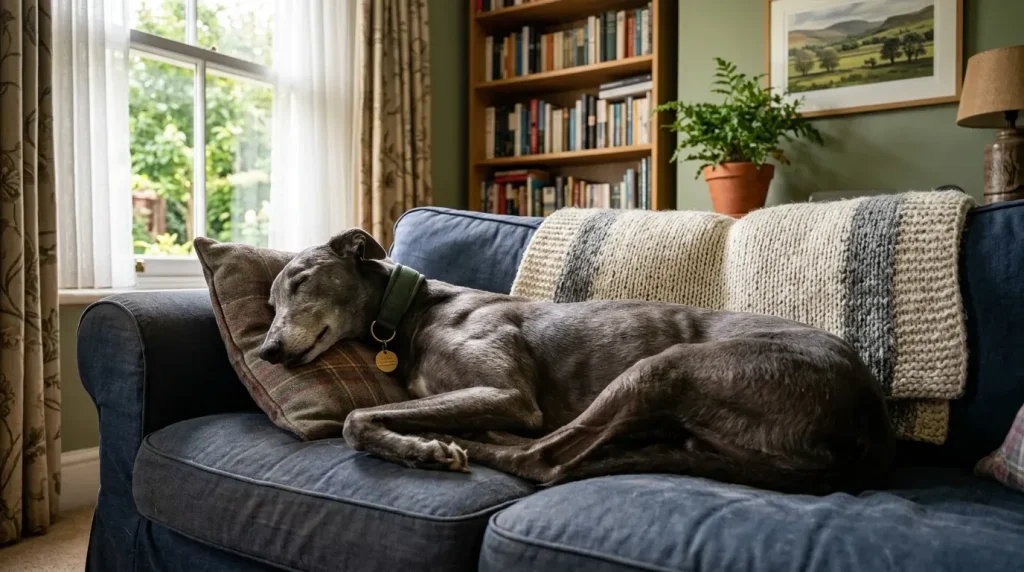
Greyhound retirement is the chapter that follows the last race — the moment a dog leaves the track for good and begins a different life. For the majority of racing greyhounds in the UK, that life involves a sofa, a garden and an owner who chose them not for their speed but for their temperament. The numbers support an optimistic picture: 94% of greyhounds leaving the racing population in 2026 were classified as successfully retired, the highest rate since GBGB began tracking the data.
But greyhound retirement is also the front line of the welfare debate. Critics argue that even 94% leaves too many dogs unaccounted for, that the system relies on charities to do work the industry should fund more generously, and that the retirement challenge will persist as long as the sport continues to produce more dogs than the adoption market can absorb. Understanding how retirement works — the data, the process and the experience of living with a retired racer — is relevant to anyone who follows the sport, whether they are punters, fans or potential adopters.
GBGB Retirement Statistics — 94% Successfully Rehomed
The GBGB publishes retirement data annually, and the 2026 figures show meaningful progress. Of the greyhounds that left the racing population during the year, 5,795 — or 94% — were classified as successfully retired. This means they were rehomed as pets, returned to their owners, placed through Greyhound Trust branches or adopted through other GBGB-approved channels.
The trajectory has been consistently upward. In 2018, the equivalent figure was 88%, which means the industry has gained six percentage points in six years. The improvement reflects a combination of factors: greater funding for rehoming programmes, increased public demand for retired greyhounds as pets, and stronger regulatory pressure on trainers and owners to account for every dog leaving their care.
The most dramatic change in the retirement data concerns economic euthanasia — the practice of putting down a healthy dog because the owner cannot afford or does not wish to pay for treatment or rehoming. In 2018, 175 greyhounds were euthanised for economic reasons. In 2026, that number was three. The 98% reduction is the single most striking welfare improvement in the dataset, and it reflects a cultural shift as much as a policy change. The Injury Retirement Scheme, which has distributed nearly £1.5 million in veterinary funding since its launch in December 2018, has been instrumental in this — it removes the financial barrier that once made euthanasia the default response to a career-ending injury.
The remaining 6% of dogs not classified as successfully retired is the number that draws scrutiny. GBGB’s data does not fully account for every dog in this category — some may be in transitional care, some may have been exported, and some may have died of natural causes. The critics’ contention is that any gap in the accounting represents a potential welfare failure, and they are not wrong to push for more complete data. The industry’s contention is that 94% represents a genuine and substantial achievement from a system that was significantly worse just six years earlier, and they are not wrong either.
Adopting a Retired Greyhound — How the Process Works
The Greyhound Trust is the primary rehoming charity for retired racing greyhounds in the UK, operating through a network of regional branches that cover most of England and Wales. The adoption process is designed to be thorough without being prohibitive — the Trust wants to place dogs in suitable homes quickly, but it also needs to ensure that the match is right for both the dog and the adopter.
The process typically begins with an application, submitted through the Greyhound Trust website or by contacting a local branch directly. The application covers basic information: your living situation, garden access, other pets, work schedule and experience with dogs. A volunteer from the branch then conducts a home check — a visit to your property to assess its suitability for a greyhound. This is not a judgement on your housekeeping; it is a practical assessment of whether the space is safe and appropriate for a large, athletic dog that is accustomed to kennel life.
Once approved, the branch matches you with a suitable dog based on temperament, energy level and compatibility with your household. Some greyhounds are calm and docile, ideal for quiet homes; others are more energetic and benefit from an active household. The matching process takes these differences into account. A trial period follows the placement, during which the Trust remains available for advice, support and — in rare cases — re-matching if the initial pairing does not work out.
The Greyhound Trust’s former Chief Executive, Lisa Morris-Tomkins, highlighted the urgency of the adoption pipeline when she stated that the number of racing greyhounds who never experience a loving home when their career is over is unacceptable. That statement predates the most recent data improvements, but it captures the moral imperative that drives the Trust’s work: every retired greyhound deserves a home, and the adoption infrastructure exists to make that possible.
Branches near Oxford include operations in Oxfordshire and the surrounding counties, meaning that dogs retiring from Oxford Stadium have direct access to local rehoming services. The proximity matters because it reduces the time a dog spends in transitional kennelling between leaving the track and entering its new home.
What to Expect — Life With a Retired Racing Greyhound
Retired greyhounds are not what most people expect. The common assumption — that a racing dog is hyperactive, difficult to manage and needs hours of daily exercise — is almost entirely wrong. In practice, retired greyhounds are among the most laid-back breeds available for adoption. They have earned the nickname “45-mile-per-hour couch potatoes” for good reason: they sprint when given the opportunity, then spend most of the remaining hours sleeping.
The adjustment period is real but typically short. A greyhound coming out of racing has lived in a kennel environment — structured meals, regular exercise, a routine dictated by the training schedule. The transition to a domestic home involves learning to navigate stairs (many have never encountered them), understanding that sofas are for sitting on (a lesson they learn enthusiastically) and adapting to the rhythms of a household rather than a kennel block. Most dogs settle within two to four weeks.
Exercise requirements are surprisingly modest. A retired greyhound benefits from two walks per day of moderate length — 20 to 30 minutes each — supplemented by the opportunity to run in a secure, enclosed area once or twice a week. They do not need the sustained exercise that breeds like collies or labradors demand, and many retired greyhounds are perfectly content with a shorter routine. Their physiology is built for explosive speed, not endurance, and their default state between bursts of activity is rest.
The temperament of most retired greyhounds is gentle, affectionate and surprisingly quiet. They are not typically barkers, they tend to be good with children and they adapt well to multi-pet households, though care is needed around small animals due to their prey drive. Each dog is an individual, and the matching process through the Greyhound Trust takes these variables into account. But as a general rule, the breed’s temperament makes retired greyhounds one of the most suitable adoption choices for first-time dog owners and families alike.
The wider context is set out in our Oxford dogs results guide.
The figures behind it are in the welfare data.
